Most of what you’ll find when you type Amazon FBA for beginners 2026 into a search bar is either a course funnel or a screenshot of someone’s revenue dashboard with the profit column conveniently cropped out. I manage Amazon accounts in the US and Mexico for a living, so let me give you the version I’d give a friend over coffee: what FBA actually is, how the flow really works, what the costs look like structurally, and when you shouldn’t use it at all.
Calculate your real Amazon profit
A spreadsheet for Amazon Mexico and Amazon USA: enter price, cost and units, and it returns the referral fee, profit per unit, margin and how many units you need to break even. Fee rates are editable, so it will not go stale. Free, no signup.
.xlsx file — opens in Excel, Google Sheets and LibreOffice.
What FBA Actually Is (and Isn’t)
FBA — Fulfillment by Amazon — means you send your inventory to Amazon’s warehouses and they handle storage, picking, packing, shipping, customer service, and returns for those orders. Your offers become Prime-eligible, which matters because a huge share of buyers filter for the badge, and fast delivery is baked into how Amazon ranks and converts.
What FBA is not: a business model. FBA is a logistics service. The business is still finding a product people want, sourcing it at a cost that leaves real margin, and marketing it better than the next seller. FBA only answers the shipping question. When a course sells you “the FBA business model,” it’s selling you the easiest twenty percent of the job.
Amazon FBA for Beginners 2026: The Real Flow
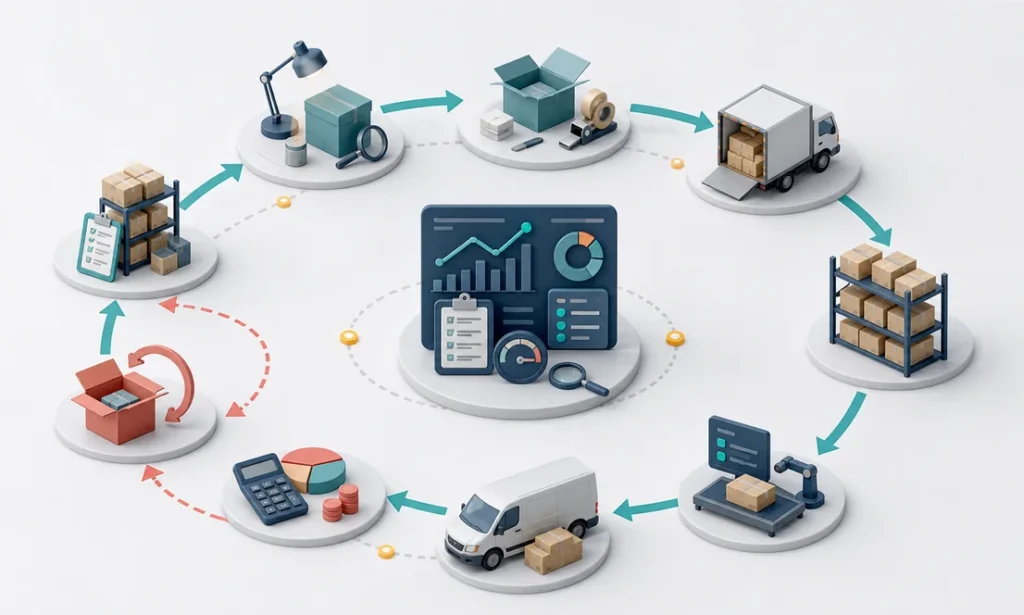
Step by step, this is what actually happens between “I want to sell on Amazon” and your first order shipping:
- Open a seller account. Amazon offers an individual plan and a professional plan. If you’re at all serious, you’ll end up on professional — features that matter, like full advertising access, depend on it.
- Choose and source a product. This is the hard part, and it happens entirely outside FBA: demand research, supplier vetting, samples, and margin math that includes every fee plus advertising.
- Create your listing. Title, bullets, images, backend keywords. Your conversion rate lives or dies here, long before logistics matter.
- Prep and ship inventory to Amazon. Products need correct labeling and prep to be accepted at fulfillment centers, and your shipment plan dictates which warehouses receive what.
- Amazon fulfills your orders. Storage, pick, pack, ship, customer service, returns.
- You manage everything else. Advertising, pricing, restock timing, account health, catalog issues. FBA touches none of that, and that’s where accounts are won or lost.
The Cost Structure, With No Made-Up Numbers
I’m deliberately not quoting dollar amounts here, because Amazon’s fees change and every guide with hard numbers in it goes stale. What a beginner needs is the structure:
- Selling plan. Individual vs professional — one charges per item sold, the other a flat monthly subscription.
- Referral fee. A percentage of each sale that varies by category. This applies whether you use FBA or not.
- FBA fulfillment fee. Charged per unit, based on size and weight tiers. Ounces and inches matter more than beginners expect — a small packaging change can move you between tiers.
- Storage fees. Monthly, higher during Q4, with surcharges for inventory that sits too long. Slow-moving stock quietly eats margin.
- Everything optional. Advertising, coupons, premium services — controllable, but rarely optional in practice if you want visibility.
Before you order inventory, pull the current rates from Amazon’s published fee schedule and run your margin per unit with real numbers. The most common beginner death I see isn’t a bad product — it’s a product that looked profitable until every fee plus advertising was actually included.
When FBM Beats FBA
FBM (Fulfilled by Merchant) means you ship orders yourself or through a third-party logistics provider. Courses barely mention it because it’s less packaged, but there are cases where FBM is simply the better call:
- Oversized or heavy items, where size-and-weight-based FBA fees can crush the margin.
- Slow movers, where monthly storage and aged-inventory surcharges outweigh the convenience.
- Fragile, customized, or made-to-order products that don’t survive standardized warehouse handling.
- You already have fulfillment — a warehouse, staff, and carrier accounts running for other channels.
Plenty of real accounts run hybrid: FBA on fast movers for the Prime badge, FBM as backup and on products where the math favors it. If you run your own warehouse alongside FBA, keeping inventory synced across channels is where spreadsheets start breaking — that’s typically when sellers bring us integration work through custom software development, connecting Amazon data with their inventory and accounting systems.
The Myths Courses Keep Selling
- “Passive income.” There is nothing passive about restock planning, advertising, and account health. FBA removes boxes from your garage, not work from your week.
- “Find a winning product in a weekend.” Product selection is the highest-stakes decision in the whole model. Rushing it is how people end up with a pallet of unsellable inventory.
- Revenue screenshots. Revenue is not profit. Any screenshot without fees, ad spend, and cost of goods shown is marketing, not proof.
- “Amazon is too saturated.” The opposite myth, equally wrong. It’s saturated for me-too products chosen from the same software everyone uses. Differentiated products with real margins still win every day.
FAQ
How much money do I need to start Amazon FBA in 2026?
I won’t hand you a single number, because it depends on your product’s unit cost, the supplier’s minimum order, and your category’s advertising intensity. The principle that matters: whatever your first inventory order costs, budget meaningfully beyond it for launch advertising and a second order. Running out of stock right when a launch works is one of the most expensive mistakes a beginner can make.
Do I need an LLC or company to start?
Amazon allows individuals to sell, and requirements differ by situation and country. Entity structure and tax questions are for your accountant, not for a blog post or a course — get that advice before serious money moves, and treat anyone selling you a one-size-fits-all answer with suspicion.
Is FBA still worth it in 2026?
As a logistics service, usually yes — the Prime badge and fulfillment infrastructure are hard to match on your own. As a get-rich-quick scheme, no, and it never was. Treat any Amazon FBA for beginners 2026 content promising fast, effortless money as the advertisement it is.
If you’d rather skip the expensive first-year mistakes, this is what we do daily — store setup, listings, and sourcing are all part of our Amazon account management service. Schedule a call and we’ll look at your plan before you commit money to it.
Keep reading
- Amazon Wholesale vs Private Label: Which Is Better?
- How Much Does Amazon Account Management Cost in 2026?
- How to Sell on Amazon Mexico: a Guide for US Brands
Would you rather have us run it? See our Amazon account management service.
Finding this analysis useful?
Get one email a week with the most important developments in AI and business technology — explained in plain English, with real numbers and zero spam.
Want this working in your business?
Book a free 30-minute session: we look at your case and tell you what is worth doing (and what is not) — no strings, no sales pitch.
Book a free session →