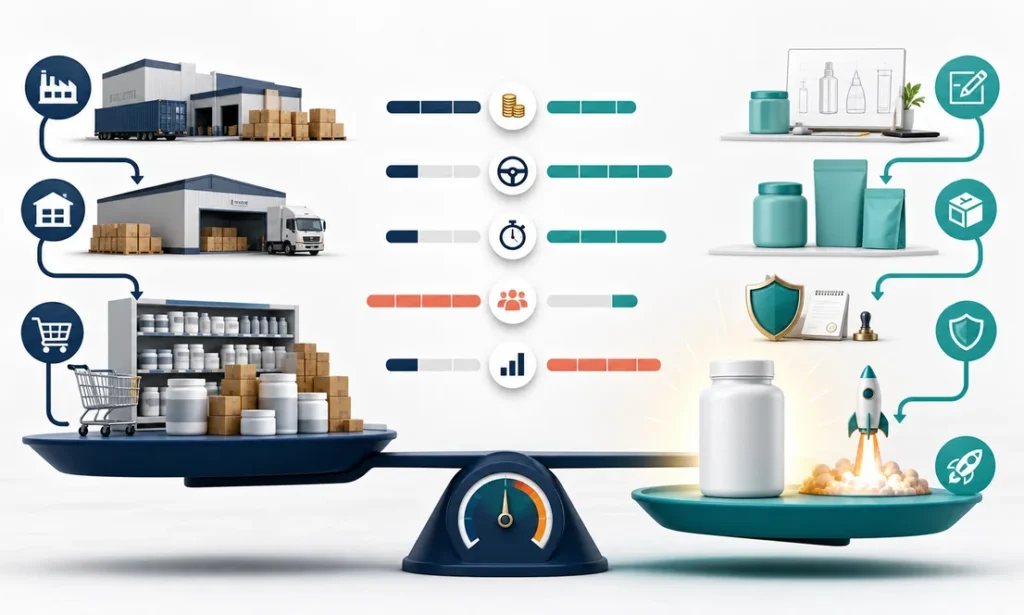
“Should I do wholesale or private label?” is probably the question I hear most from people getting serious about selling on Amazon. The honest answer to the Amazon wholesale vs private label question is that neither is better in the abstract — they’re two different businesses that happen to share a sales channel. I operate accounts on Amazon US and Amazon Mexico, and the sellers who struggle are almost always the ones who picked a model that doesn’t match their capital, their patience, or their appetite for operations.
Here’s how the Amazon wholesale vs private label decision actually breaks down: the real differences, a table you can use today, and the part most gurus skip — what each model demands from you operationally.
The Two Models in Plain Terms
Wholesale means buying established brands’ products at wholesale prices from the brand itself or an authorized distributor, then reselling them on Amazon — usually on listings that already exist. You don’t own the listing or the brand. You’re competing with other resellers for the Buy Box, mostly on price and fulfillment quality.
Private label means creating your own branded product, typically by finding a manufacturer to produce your spec or customize an existing product, then building a listing from scratch. You own the brand, the listing, and the customer’s perception of both. Nobody shares your detail page.
That single difference — shared listing versus owned listing — drives almost everything else about how the two models feel to run.
Amazon Wholesale vs Private Label: The Decision Table
| Model | Makes sense when | Wrong fit when |
|---|---|---|
| Wholesale | You want revenue moving sooner on products with proven demand. You’re comfortable with thinner margins offset by volume. You’re good at relationships, because opening real wholesale accounts with brands and distributors is a sales job. You can handle many SKUs and fast-moving inventory without dropping balls. | You hate the idea of racing other resellers to the bottom on price. You want to build an asset you could eventually sell for a meaningful multiple. You don’t have the stomach for chasing distributors, filling out applications, and getting told no regularly before the yeses arrive. |
| Private label | You can wait months before real traction and fund inventory, photography, and launch advertising without panicking. You want to own something: brand, listing, pricing power. You’re willing to obsess over genuine product differentiation instead of cloning whatever is already selling. | You need cash flow quickly. Your budget barely covers the first inventory order with nothing left for a launch. Or you picked your product from a “best products to sell this year” video that a hundred thousand other people also watched. |
Margins, the Buy Box, and Who Controls What
In wholesale, the game is the Buy Box. Multiple sellers sit on one listing and Amazon rotates the featured offer among competitive ones. Your levers are price, fulfillment method, and account health — which means margins compress every time a new reseller shows up willing to earn less than you. Per-unit margins are structurally thinner, and the daily work is operational: sourcing new accounts, reordering fast movers before they stock out, and keeping dozens or hundreds of SKUs priced correctly. At that SKU count, doing repricing checks and purchase-order workflows by hand stops scaling — it’s exactly the kind of repetitive, rules-based work we build business process automation for.
In private label, you own the listing, so the fight moves from the Buy Box to the search results page. Your levers become listing quality, reviews, advertising, and brand. Margins are structurally better because no identical competing offer exists, but you pay for that upfront: product development, inventory risk, and a launch period where advertising eats a large share of revenue before organic rank arrives.
Either way, know the fee structure before committing to margin math. Amazon takes a referral fee that varies by category, plus FBA fees based on size and weight if you use their fulfillment. I’m not quoting numbers here because they change — check Amazon’s published fee schedule and build your spreadsheet from current rates, not from a blog post.
Where Private Label Gets Real: Sourcing
Here’s the part that separates private label businesses from private label hobbies: the manufacturer. Most first-timers source through a directory marketplace, take the first supplier who answers politely, and never verify whether that “factory” actually makes the product or just brokers it. Then the second production run arrives with different materials, or lead times double right before Q4, and the listing’s review history pays the price permanently.
Getting sourcing right means vetting factories, comparing quotes on identical specs, negotiating terms and lead times, and having someone verify production before it ships. This is work we do directly for clients — manufacturer matchmaking in Asia is a core piece of our Amazon account management service, because in private label the supplier relationship isn’t a side errand. It’s the foundation the entire brand sits on. A mediocre factory caps your quality, your margin, and your ability to scale, no matter how sharp your marketing is.
Can You Run Both?
Yes, and plenty of sellers do: wholesale for cash flow, private label for equity. The models even teach each other. Wholesale shows you how categories move and how the Buy Box actually behaves; private label teaches you listings, advertising, and brand-building. If you go this route, keep the books and the expectations separate. Wholesale profit funding private label launches is a sound play. Blending them until you can’t tell which one is working is not.
My Honest Take
If I had limited capital and needed income soon, I’d start with wholesale and learn the platform on proven demand. If I had patience, funding, and a real product idea — not a copy of a bestseller — I’d go private label, because owned listings compound and shared listings don’t. The mistake isn’t picking either model. It’s picking private label with wholesale expectations of speed, or wholesale with private label expectations of margin.
Weighing the two models for your situation, or trying to find a manufacturer you can actually trust? Schedule a call and let’s map it out together.
Keep reading
- Amazon FBA for Beginners (2026): the No-Hype Guide
- Amazon Brand Registry: Requirements and Why It’s Step One
- How to Sell on Amazon Mexico: a Guide for US Brands
Would you rather have us run it? See our Amazon account management service.
Finding this analysis useful?
Get one email a week with the most important developments in AI and business technology — explained in plain English, with real numbers and zero spam.
Want this working in your business?
Book a free 30-minute session: we look at your case and tell you what is worth doing (and what is not) — no strings, no sales pitch.
Book a free session →