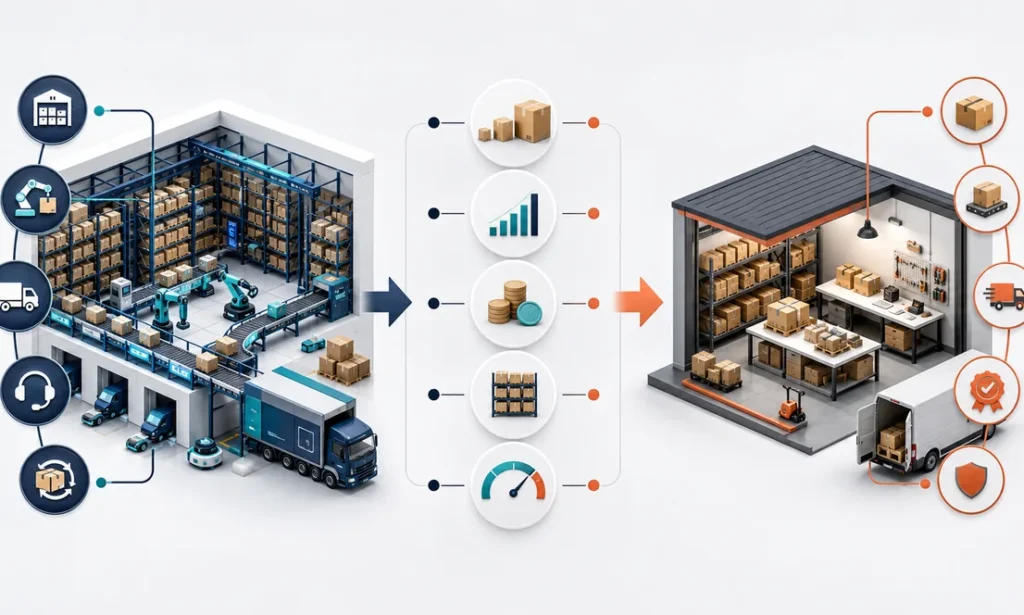
The FBA versus FBM decision gets framed as a religious argument, and it is not. It is arithmetic with a couple of judgment calls attached. FBA means Amazon stores your inventory and ships it. FBM means you store it and ship it yourself.
Both work. The one that fits depends on your product’s weight, your margin and how fast it sells.
What each one actually costs you
With FBA you pay a fulfillment fee per unit based on size and weight, plus monthly storage based on the volume you occupy. You get Prime eligibility, Amazon handles returns and customer service, and your listing competes better for the Buy Box.
With FBM you pay the real cost of shipping each order, plus the packaging, plus the hours somebody spends picking and packing. That last cost is the one sellers forget. If you are packing forty orders on a Saturday, that time is not free just because it does not show up on an invoice.
When FBM is the better answer
- Heavy or bulky products. FBA fees scale with size, and past a certain point they eat the whole margin.
- Slow movers. Storage is charged by time and volume. Inventory that sits for months in a fulfillment center quietly bleeds you, and long-term storage surcharges make it worse.
- Products you already ship anyway. If you run a warehouse for your own store, the marginal cost of one more order is small.
- Fragile, custom or made-to-order items that need handling Amazon will not give them.
When FBA is the better answer
- Small, light, fast-moving products. This is where FBA is cheapest per unit and hardest to beat on your own.
- When you want Prime. Prime eligibility changes conversion, and for many categories it is the difference between selling and being invisible.
- When your time is the bottleneck. If shipping orders is stopping you from sourcing products or fixing listings, FBA buys back the hours.
- When you cannot hit delivery targets. FBM has performance metrics. Miss them and Amazon restricts your account.
The hybrid nobody talks about
You do not have to pick one for the whole catalog. The setup I see work most often is FBA for the small fast movers, FBM for the heavy or slow ones, decided SKU by SKU rather than as a company policy.
Some sellers also keep an FBM listing as a backup on their FBA products. When FBA stock runs out, the FBM offer keeps the listing alive instead of letting it go dark and lose ranking.
How to decide, concretely
Do this per SKU, not for the whole business:
- Take your selling price and subtract product cost and the referral fee for your category.
- Now subtract the FBA fulfillment fee plus estimated storage. Write down the result.
- Now instead subtract your real shipping cost, packaging, and an honest hourly value for the labor. Write down that result.
- Compare. Then ask the question the spreadsheet cannot answer: does losing Prime change how much of this you sell?
If the numbers are close, FBA usually wins on volume, because Prime moves conversion. If FBM wins by a wide margin, it is almost always a heavy product or a slow one.
The FBA costs people forget
The fulfillment fee is the number everyone compares. It is not the number that surprises them later:
- Inbound shipping. Getting inventory to the fulfillment center is on you, and Amazon may split your shipment across multiple centers.
- Prep requirements. Polybagging, labeling, bubble wrap for fragile items. Do it yourself or pay Amazon per unit to do it.
- Long-term storage surcharges. Inventory that ages past the threshold gets charged extra, on top of normal storage.
- Removal or disposal fees. Getting unsold inventory back out costs money too, and it is the fee that catches people when a product fails.
- Returns processing. Convenient, but a returned unit often comes back unsellable, and that is inventory you paid for twice.
None of these make FBA a bad deal. They just mean the honest comparison is total landed cost per unit sold, not the fulfillment fee alone.
Does the answer change between Amazon US and Amazon Mexico?
Yes, in two ways worth knowing before you assume your US playbook transfers.
First, the fee structures are different, and so are the distances. Mexico’s fulfillment network is more concentrated, which changes how much a heavy product costs to move.
Second, and more important, buyer expectations differ. Prime penetration is not identical across the two marketplaces, so the conversion lift you get from Prime eligibility is not the same either. In the US, losing Prime is often fatal for a competitive product. In Mexico, FBM remains viable in more categories than US sellers expect.
If you sell in both, run the math per marketplace. The same SKU can genuinely deserve FBA in one and FBM in the other.
FAQ
Can I switch later?
Yes, and most sellers do. Plenty start FBM to keep cash free while validating the product, then move winners to FBA once they know what rotates.
Does FBA guarantee the Buy Box?
No. It helps, because fulfillment and delivery speed feed into it, but price, account health and stock availability still matter.
What about returns?
With FBA, Amazon handles them, which is convenient but means you get returned units back in varying condition. With FBM, returns are your problem operationally but you keep control of the process.
Keep reading
- Amazon FBA for Beginners (2026): the No-Hype Guide
- How Much Does Amazon Account Management Cost in 2026?
- How to Sell on Amazon Mexico: a Guide for US Brands
Would you rather have us run it? See our Amazon account management service.
Finding this analysis useful?
Get one email a week with the most important developments in AI and business technology — explained in plain English, with real numbers and zero spam.
Want this working in your business?
Book a free 30-minute session: we look at your case and tell you what is worth doing (and what is not) — no strings, no sales pitch.
Book a free session →