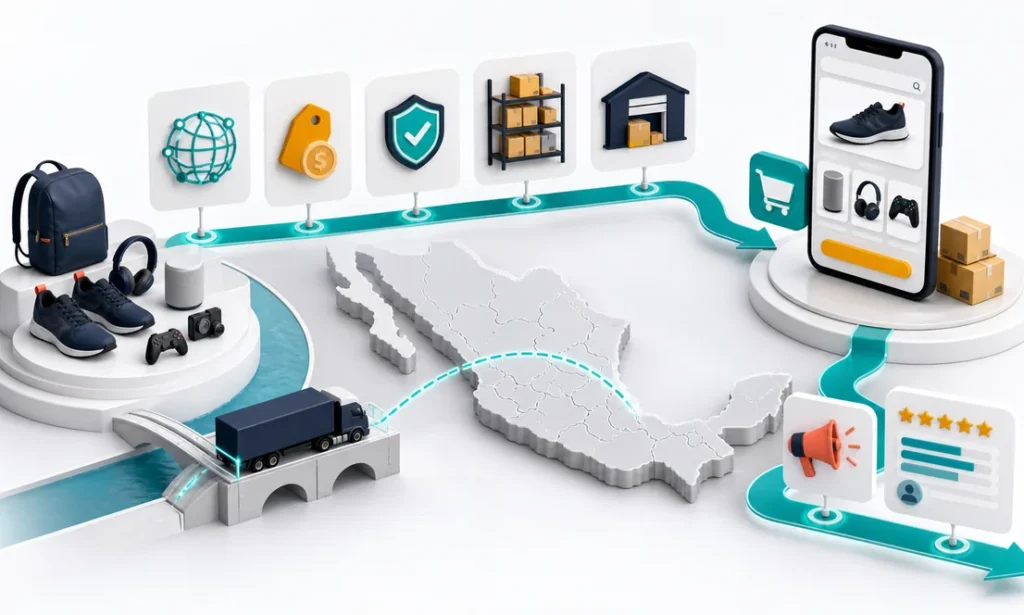
I run Amazon accounts on both sides of the border, in Amazon US and Amazon Mexico, and the question American brands ask me most often is whether it makes sense to sell on Amazon Mexico. My honest answer: for most established US sellers, yes, and probably sooner than you think. It is a growing marketplace with noticeably less competition than the US, and if you already operate a Seller Central account, a big part of the infrastructure you need is already in place. This guide covers what I actually do when I take a US brand south: the requirements, the listing work, the fulfillment decisions, and the mistakes that cost sellers months.
Calculate your real Amazon profit
A spreadsheet for Amazon Mexico and Amazon USA: enter price, cost and units, and it returns the referral fee, profit per unit, margin and how many units you need to break even. Fee rates are editable, so it will not go stale. Free, no signup.
.xlsx file — opens in Excel, Google Sheets and LibreOffice.
Why Amazon Mexico Deserves a Spot on Your Roadmap
The US marketplace is brutally mature. In most categories, page one is a knife fight between established brands with deep review moats and aggressive advertising budgets. Amazon Mexico is a different picture. It is still a growing marketplace, and in many of the categories I work in, the number of serious, well-optimized competitors is a fraction of what you would face in the US. Keywords that would take a year of PPC spend to rank for up north can be reachable in Mexico with a properly localized listing and a modest launch push.
Two honest caveats before you get excited. First, the Mexican market is smaller in absolute terms, so treat it as incremental revenue and a strategic foothold, not a replacement for your US business. Second, expansion amplifies whatever you already are. If your US account is disorganized or your listings underperform, going cross-border will not fix that; it will duplicate it in a second language.
What You Need Before You Sell on Amazon Mexico
The good news: Amazon makes the account side relatively painless for existing US sellers. Here is the practical checklist I walk brands through:
- A North America unified account. If you sell in the US through Seller Central, your account can typically be extended to the Mexican marketplace without creating a separate account. Confirm your account status inside Seller Central, since program details evolve.
- A tax conversation. Mexico has its own tax rules for marketplace sellers, and Amazon applies withholding rules that differ depending on your registration status there. I am an operator, not a tax advisor, so my standing advice is the same for every brand: verify the current rules in Seller Central and talk to a professional who handles cross-border ecommerce before your first sale, not after.
- A plan for getting paid. Amazon can disburse funds from Mexican sales to sellers abroad through its currency conversion options. Review the current terms so exchange costs do not quietly eat your margin.
- Your brand protection in order. If you are enrolled in Brand Registry, look into extending your protections and A+ content to the Mexican marketplace. It is far easier to launch protected than to clean up problems later.
Your Listings Need Native Spanish, Not Translation
This is where most US brands stumble, and it is the hill I will die on. Machine-translated listings read exactly like what they are, and Mexican shoppers notice within one bullet point. Worse, auto-translation optimizes for nothing: the Spanish keywords people actually type into Amazon Mexico are often not literal translations of your US search terms. When I localize a listing, the title, bullets, description and backend keywords all get rebuilt around real Spanish-language search behavior, in the vocabulary Mexican customers use, not textbook Spanish and definitely not a word-for-word conversion of the US copy.
I have rewritten plenty of auto-translated listings over the years, and the pattern is always the same: the product was fine, the traffic was fine, and the conversion was dead on arrival because the page read like a robot wrote it. Native-level Spanish copy is not a nice-to-have in this marketplace. It is the entry fee.
Fulfillment: Two Ways to Get Products to Mexican Customers
You have two realistic paths, and I have run both:
- Remote fulfillment from your US inventory. Amazon offers programs that let FBA sellers serve Mexican orders from inventory already sitting in US fulfillment centers. It is the lowest-friction way to test demand because you do not export anything in advance. The trade-offs are longer delivery promises and cross-border costs, so verify the current program terms in Seller Central before you commit.
- Local FBA in Mexico. Once demand is proven, placing inventory in Mexican fulfillment centers gets you faster delivery and a stronger offer. The cost is complexity: importing into Mexico involves customs paperwork and usually an importer of record, which is exactly the kind of thing a bilingual partner earns their keep on.
My usual sequence is boring and effective: validate with remote fulfillment, then move your proven winners into local FBA.
The Mistakes I See Most Often
- Auto-translating the catalog and wondering why nothing converts.
- Copying US pricing blindly without accounting for exchange rates, cross-border fees and local price sensitivity.
- Ignoring customer messages and reviews in Spanish. Slow or English-only responses hurt your metrics and your reputation.
- Treating Mexico as set-and-forget. It is a smaller market, but it is still a live marketplace that needs monitoring, restocks and ongoing optimization.
- Launching without a measurement plan. Decide up front what success looks like at 90 days. That discipline, treating every channel like an experiment with numbers attached, is the core of the data-driven digital marketing approach we apply to everything we run.
Frequently Asked Questions
Do I need a Mexican company or a local bank account to start?
Generally no, not to get started. Most US brands begin to sell on Amazon Mexico through their existing unified account and receive disbursements abroad. Tax registration in Mexico is a separate question with real consequences, so get professional advice on your specific situation.
Can I keep all my inventory in the US?
At first, yes, through remote fulfillment programs. It is how I recommend most brands test the market. Once a product proves itself, local FBA almost always wins on delivery speed and conversion.
How long does a launch take?
In my experience the long pole is rarely the account setup; it is doing the listing localization properly. For a focused catalog, think in weeks, not months, provided the Spanish copywork is resourced from day one.
This cross-border work, setup, localization, logistics guidance and ongoing optimization, is exactly what our Amazon account management service was built around, run by a bilingual team that operates in both marketplaces every day.
Thinking about taking your brand into Mexico? Schedule a call and we will look at your catalog together and tell you honestly whether it is ready.
Keep reading
- Amazon FBA for Beginners (2026): the No-Hype Guide
- How Much Does Amazon Account Management Cost in 2026?
- Amazon Brand Registry: Requirements and Why It’s Step One
Would you rather have us run it? See our Amazon account management service.
Finding this analysis useful?
Get one email a week with the most important developments in AI and business technology — explained in plain English, with real numbers and zero spam.
Want this working in your business?
Book a free 30-minute session: we look at your case and tell you what is worth doing (and what is not) — no strings, no sales pitch.
Book a free session →