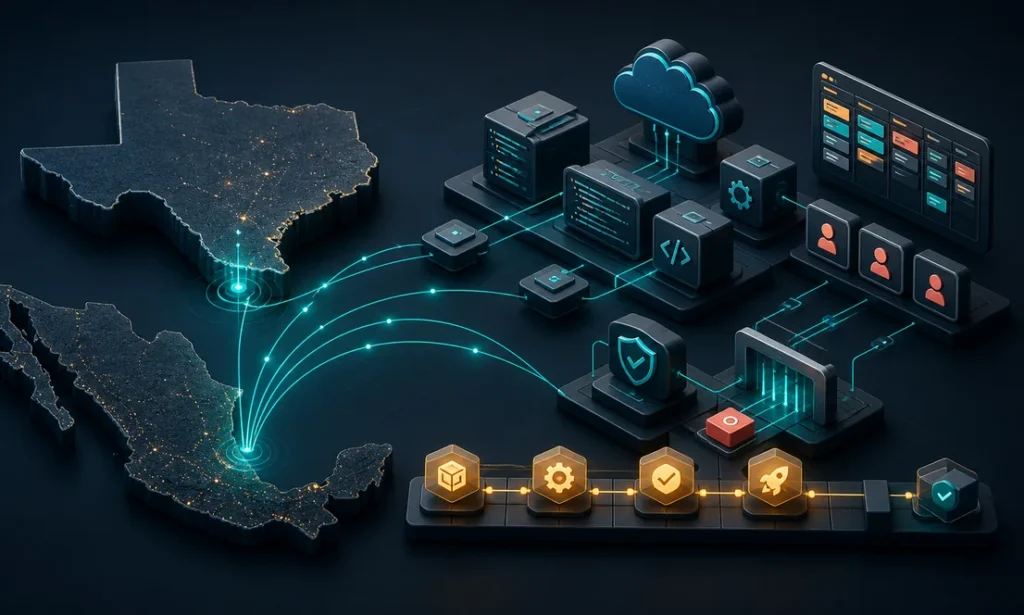
For years, “hiring developers across the border” was something only big corporations did — they had the lawyers, the travel budgets, and the patience for it. That’s changed. Nearshore for small business is now one of the most practical moves a Texas owner can make when the software quotes from local shops come back with more zeros than the truck cost. This guide explains what nearshore actually means, why Texas businesses in particular are wired for it, what it costs, and — because I’d rather lose a sale than mislead you — when it’s the wrong move.
What “Nearshore” Means (and What It Doesn’t)
Offshore means your development team works while you sleep — India, Eastern Europe, Southeast Asia. Emails cross in the night; a small misunderstanding costs a full day. Nearshore means the team sits in your time zone or one adjacent to it. For Texas, that’s Mexico: a senior engineer in Chihuahua or Monterrey is on US Central Time, answers your 10 a.m. call at 10 a.m., and can be in your office in hours, not days, if the project ever needs a handshake.
Here’s the analogy I use: offshore is mail-order; nearshore is a supplier one town over. Both can deliver good parts. Only one can swing by when something needs sorting out today.
Why Nearshore for Small Business Suddenly Makes Sense
Three things converged. First, the price of US development kept climbing: dev shops in Austin and other metros typically bill $120–$250 per hour, and a senior US-based engineer runs $12,000–$18,000 a month once you count salary and overhead. A comparable senior nearshore engineer typically costs $4,500–$8,000 a month. That’s not a rounding error — for a small company, it’s the difference between “we can afford custom software” and “we can’t.”
Second, the tooling caught up. Video calls, shared code platforms, and project boards mean a team two borders away works the same way a team two floors away does. The daily rhythm — morning check-in, afternoon demo, questions answered in minutes — feels local because, on the clock, it is.
Third, the legal framework matured. Under the USMCA trade agreement, US companies work with Mexican service providers inside a stable, familiar structure — contracts, IP protection, and invoicing that your attorney and your CPA can both read without a translator. This isn’t a gray-market arrangement; it’s the same framework moving billions in goods and services across the border every year.
What Working With a Nearshore Team Actually Looks Like
- You talk to engineers, not a sales layer. Good nearshore teams put fluent-English senior people directly in your meetings. If a provider hides the builders behind an account manager, keep shopping.
- Fixed-price stages, not open meters. The structure we use — and recommend you demand from anyone — is staged delivery at fixed prices, with a first working module in 8–12 weeks. You see real software running before you’ve bet the whole budget.
- Same-day collaboration. Because of the time zone overlap, your feedback at lunch is in the build by end of day. That loop speed is where nearshore quietly beats offshore, and it’s explained in more depth on our nearshore software development page.
- Senior supervision over AI shortcuts. Plenty of cheap code is being generated by AI these days, and unsupervised AI code commonly ships with the security flaws cataloged by OWASP. A disciplined senior team uses AI as a power tool, with an experienced engineer holding the handle — the difference matters most for anything touching customer data.
The Honest Math for a Texas Owner
Say you need a custom scheduling and invoicing system. At Austin-metro rates of $120–$250 an hour, a serious build gets expensive fast — which is why so many owners get quotes, wince, and go back to duct-taping spreadsheets. The nearshore version of the same project, staffed with senior engineers at $4,500–$8,000 a month instead of $12,000–$18,000, typically lands 40–60% below US pricing for equivalent scope. Businesses comparing local options can see how we position against Austin shops on our custom software development for Austin page.
One caution from the shop floor: don’t pick the cheapest bid anywhere — nearshore, offshore, or local. You’re buying judgment, not just hours. A team that pushes back on a bad idea is worth more than one that says yes to everything.
When Nearshore Is NOT Your Answer
- Your project is tiny. If an off-the-shelf tool at $200–$600 a month per user genuinely covers your workflow, start there. Custom anything — nearshore or not — needs a problem big enough to justify it.
- You can’t name an owner for the project. Every software project needs one person on your side who answers questions weekly. No time for that means no project, at any price.
- You’re required to keep work onshore. Certain government contracts have residency requirements. Check yours first.
Frequently Asked Questions
Is the language barrier real?
With the right team, no. Senior engineers who work with US clients daily operate in fluent, idiomatic English — meetings, documentation, and code comments included. Judge it in the first call: if you’re not understood instantly, that’s your answer.
Who owns the code?
You do, if the contract says so — and it must. Under USMCA-framework agreements, IP assignment to your company is standard practice. Never sign with anyone, anywhere, who keeps ownership of your software.
Is nearshore for small business only about saving money?
Cost opens the door, but owners tend to stay for the working rhythm: same hours, fast answers, senior people who stick with the account instead of rotating away every quarter.
If a local quote made your eyes water, get a second opinion before you shelve the project. Schedule a free consultation and we’ll price your idea in plain USD, stage by stage.
Finding this analysis useful?
Get one email a week with the most important developments in AI and business technology — explained in plain English, with real numbers and zero spam.
Want this working in your business?
Book a free 30-minute session: we look at your case and tell you what is worth doing (and what is not) — no strings, no sales pitch.
Book a free session →