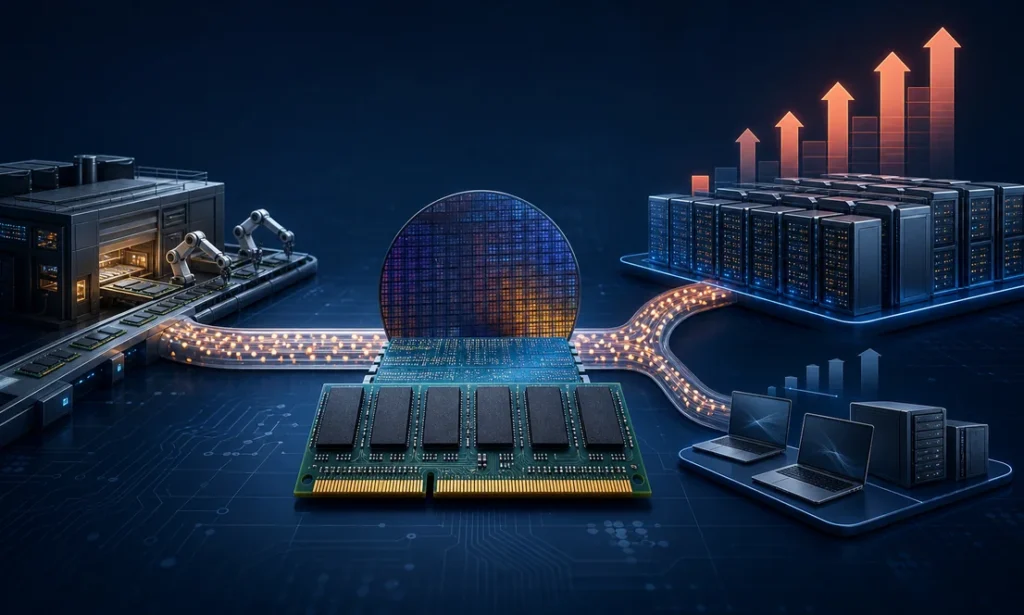
If you quoted laptops for your team recently and assumed the price was a typo, it wasn’t. The memory shortage that began in late 2025 is still running through the third quarter of 2026: on July 3, TrendForce projected conventional DRAM contract prices would climb another 13% to 18% this quarter, and on July 10, SK Hynix CEO Kwak Noh-jung said 2027 will be “the worst year in the industry’s history from the supply perspective.” The newest wrinkle is that the increases are finally slowing — not because more chips exist, but because PC makers have hit the ceiling of what buyers will pay. For anyone running a business, RAM prices in 2026 change three concrete decisions: when to refresh hardware, where to put your servers, and how much to budget for IT in 2027.
The 60-second summary
- AI data centers absorbed memory manufacturing capacity. Makers shifted wafers toward HBM — the high-bandwidth memory stacked next to AI accelerators — leaving PC and phone DRAM short.
- Gartner estimates a 130% combined surge in DRAM and SSD prices by the end of 2026 versus 2025, pushing PC prices up 17% and smartphone prices up 13%.
- Memory went from 16% of a PC’s component bill of materials in 2025 to 23% in 2026.
- TrendForce sees conventional DRAM contract prices rising 13-18% quarter over quarter in 3Q26 and NAND (SSDs) 10-15%. The market remains “extremely tight.”
- SK Hynix expects demand to exceed its supply capacity beyond 2030. This is not a one-quarter blip.
- What it means: hardware costs more and stays in service longer, on-premise infrastructure gets more expensive relative to cloud, and any project that depends on buying servers needs a bigger contingency or a different design.
What actually happened, without the jargon
Picture a bakery that has always supplied neighborhood corner stores. One morning a restaurant chain offers to pay four times the price for the entire day’s output. The bakery doesn’t magically expand — it just serves the customer paying more. The corner stores are still there, but they get less bread at a higher price.
That is the memory market. Fabs at SK Hynix, Samsung and Micron have installed capacity that takes years and tens of billions of dollars to expand. When AI infrastructure spending exploded, those fabs redirected wafers toward HBM, a stacked memory type mounted next to AI accelerators that sells at far better margins. The ordinary DDR5 in your laptop and the LPDDR in your phone moved to the back of the line.
The result isn’t a pandemic-style shortage where nothing is available. Product exists — at auction prices. And because memory ships inside nearly everything (laptops, phones, consoles, servers, cameras, point-of-sale terminals, industrial controllers), the increase leaks into half the economy.
Why this one doesn’t self-correct quickly
Previous memory crunches lasted a few quarters because they were inventory cycles: makers overproduced, prices collapsed, they cut output, prices rose, they produced again. This time the driver is structural. AI data center buildouts are multi-year commitments with contracts signed in advance. That is why the SK Hynix CEO is describing 2027 as the worst year on record and an imbalance stretching past 2030, not “a few difficult months.”
The hard numbers
| Metric | Figure | Source and date |
|---|---|---|
| Combined DRAM + SSD price surge by end of 2026 (vs. 2025) | +130% | Gartner, February 2026 |
| Impact on PC prices in 2026 (vs. 2025) | +17% | Gartner, February 2026 |
| Impact on smartphone prices in 2026 (vs. 2025) | +13% | Gartner, February 2026 |
| Memory share of a PC’s bill of materials | 16% (2025) → 23% (2026) | Gartner, February 2026 |
| Projected decline in global PC shipments, 2026 | -10.4% | Gartner, February 2026 |
| Projected decline in global smartphone shipments, 2026 | -8.4% | Gartner, February 2026 |
| Conventional DRAM contract price change, 3Q26 | +13% to +18% QoQ | TrendForce, July 3, 2026 |
| NAND flash (SSD) contract price change, 3Q26 | +10% to +15% QoQ | TrendForce, July 3, 2026 |
| Year the industry expects to be worst for supply | 2027 | SK Hynix (Kwak Noh-jung), July 10, 2026 |
| Disappearance of the sub-$500 PC segment | Projected by 2028 | Gartner, February 2026 |
What does this mean for your business?
In a free 30-minute session we'll show you how to put technology like this to work in your operation — no hype, real numbers, concrete steps.
What those numbers actually mean
“+130%” does not mean your laptop doubles in price. That is the input cost, not the finished product. Because memory represents roughly a fifth of component cost, Gartner’s estimated effect on the shelf price is +17% for PCs. On a $1,200 business laptop, that is about $204 per unit — roughly $3,060 more for a 15-person refresh than the same purchase would have cost in 2025.
The shipment decline (-10.4% for PCs) is the part most people misread. Demand for computers didn’t evaporate; people are holding onto them longer. Practically, that also tightens the refurbished and secondary market, because fewer companies are releasing their old fleet.
The sub-$500 PC segment disappearing by 2028 is the most uncomfortable signal. That is exactly where most small businesses buy administrative hardware. If the floor rises, the question stops being “which cheap laptop do we buy” and becomes “how many machines do we actually need, and what can move to a browser or a thin client.”
This quarter’s slowdown is not good news. Increases are moderating in 3Q26 because PC and phone makers hit the limit of what buyers tolerate, not because supply improved. When the brake comes from demand rather than supply, what usually adjusts is the specification: same price, 8 GB instead of 16, or a smaller SSD. Read the spec sheet, not just the price tag.
Grounded costs: a 20-person company
A 20-employee firm that refreshes a third of its fleet every year. Same hardware, 2025 reference pricing versus 2026 pricing at Gartner’s estimated increase:
| Line item | 2025 reference | With +17% (2026) | Difference |
|---|---|---|---|
| 7 business laptops ($1,200 each) | $8,400 | $9,828 | +$1,428 |
| 2 design/CAD workstations ($2,100 each) | $4,200 | $4,914 | +$714 |
| 1 entry-level on-premise server ($4,200) | $4,200 | $4,914 | +$714 |
| Annual refresh total | $16,800 | $19,656 | +$2,856 |
The reference prices are illustrative — every quote varies by brand and reseller — but the percentage is Gartner’s 2026 projection. The exact figure matters less than the pattern: a mid-sized company’s hardware line grows by a few thousand dollars a year that nobody approved. And if your plan was to buy servers in 2027, the year the industry flags as the worst, the adjustment gets larger.
What this means for your business
1. If you need hardware within 12 months, pull the purchase forward
This is the opposite of the usual “wait for prices to drop” advice. With supply committed through 2027 and no meaningful new capacity before 2028, waiting doesn’t buy a better price — it buys the same machine for more. If the capital expense is already approved, executing early is a defensible financial decision.
2. Extend the life of what you already own
A 2021 laptop with an SSD and 16 GB can run two more years if you strip the software choking it and move heavy work to the browser. Before buying, take an honest inventory: how many machines are genuinely at their limit versus merely feeling slow from bloated startup items and duplicated security agents.
3. Rerun the on-premise vs. cloud math
The classic argument for a local server is that it “pays for itself in three years.” That calculation was built on 2024 hardware pricing. With memory and storage at current levels, the break-even point moves. Redo the comparison with fresh quotes before signing anything.
4. Protect the specification, not just the price
When a market tightens, the quietest way to hold a list price is to cut memory and storage. An 8 GB laptop in 2026 is a productivity complaint waiting to happen. For real office work, 16 GB is the floor; for design, engineering or development, 32 GB.
5. Software that avoids buying hardware is worth more now
This is the point that changes weight as hardware gets expensive. Every process you automate is capacity you don’t have to buy in the form of machines, licenses and seats. A data entry step eliminated, a report that generates itself, an inventory that stops being reconciled by hand — each frees hours and equipment. When hardware rises 17% a year, the return on business process automation improves automatically, because the alternative — more people on more machines — got more expensive.
6. If you build software, measure what it consumes
Memory stopped being free. Internal applications designed without regard for efficiency now translate into pricier instances every month. If you are building something new, resource requirements belong in the design conversation, not in the third month’s invoice. It is a criterion we apply when scoping any custom software project, and one reason cost-per-workload questions come up early — see our breakdown of what custom software actually costs.
7. Budget pressure makes engineering economics matter more
Hardware inflation eats budget that used to fund people. Teams facing that squeeze in 2026 have two levers: build less, or build the same for less. Nearshore development is the second lever — senior engineers in the same time zone at 40-60% below US rates — and it is the reason the hardware line and the payroll line should be reviewed in the same meeting, not separately.
How to decide in two weeks
- Build a real hardware inventory: model, year, RAM, storage, and who uses it. Without this, every decision is a guess.
- Sort into three buckets: urgent replacement (won’t survive the year), deferrable (18-24 more months with maintenance), and healthy.
- Quote the urgent bucket today and compare it against an equivalent quote from 12 months ago. That delta is your business case for buying early.
- Recalculate cloud vs. on-premise for any server you planned to buy, using this week’s pricing and a three-year horizon.
- Identify two manual processes that currently justify additional hardware or headcount, and evaluate automating them before you buy.
- Lock a minimum spec per role (office, design, field) in writing, so nobody buys an 8 GB machine to save $80.
If you want a second opinion on the break-even between buying, leasing and moving to the cloud, that is exactly the kind of decision we work through in a technology consulting session.
FAQ
Why did RAM prices go up so much?
Manufacturers redirected production capacity toward high-bandwidth memory (HBM) for AI data centers, where margins are far higher. PC and smartphone DRAM received less allocated capacity while demand held steady, so prices rose.
When will RAM prices come down?
There is no near-term signal of relief. TrendForce still projects 13-18% increases in the current quarter, and SK Hynix stated on July 10, 2026 that 2027 will be the industry’s worst supply year, with demand above capacity even after 2030. Adding fab capacity takes years.
Should I buy computers now or wait?
If you need the hardware within the next 12 months, buying now is the reasonable call — there is no credible scenario for lower prices in that window. If your current machines can last two more years with maintenance, defer and spend the budget where it returns faster.
Does this make cloud hosting more expensive too?
Indirectly and with a lag. Cloud providers buy memory on long-term contracts, so the hit doesn’t pass through immediately or at retail magnitude. Even so, audit your instances: paying for memory you don’t use costs more than it did a year ago.
Does it affect phones and other business devices?
Yes. Gartner projects +13% on smartphone prices in 2026, and the same components go into tablets, POS terminals, security cameras and industrial equipment. If your operation depends on devices, build it into the replacement budget.
Finding this analysis useful?
Get one email a week with the most important developments in AI and business technology — explained in plain English, with real numbers and zero spam.
Sources
- Gartner — Surging Memory Costs Will Reduce Global PC and Smartphone Shipments in 2026 (February 2026)
- TrendForce — AI Server Demand Continues to Support Memory Prices in 3Q26 (July 3, 2026)
- Tom’s Hardware — SK Hynix says 2027 will be the worst year for the memory shortage (July 10, 2026)
- Igor’s Lab — DRAM and NAND remain more expensive: TrendForce sees slowing but still rising prices in Q3 2026 (July 8, 2026)
Deciding this quarter between refreshing hardware, moving to the cloud, or automating the process that forces the purchase? Book a 30-minute call and we’ll work through it with your numbers.
