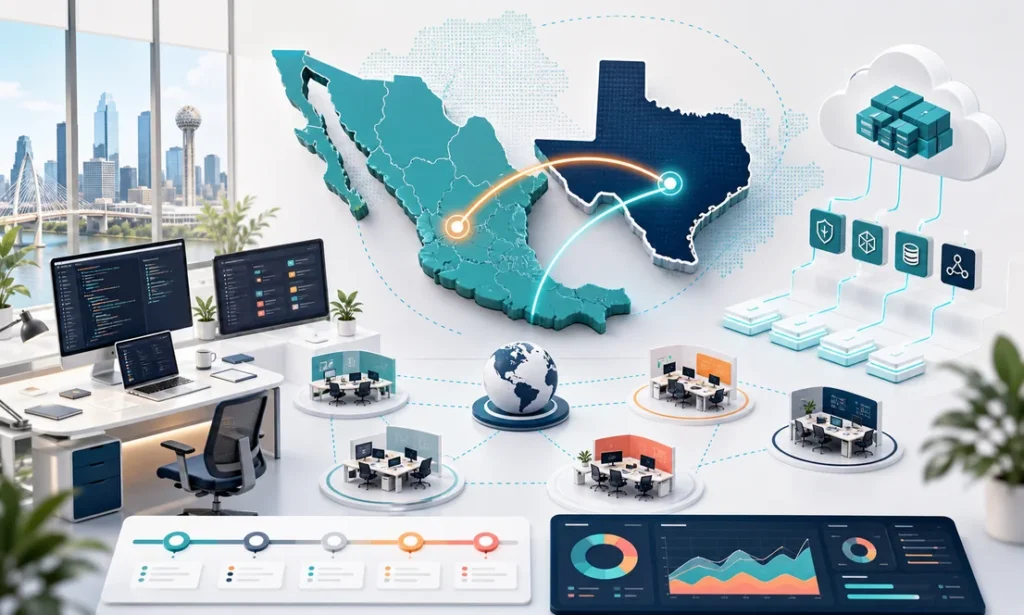
A Gulf Coast industrial distributor (real case, details anonymized) spent 14 months with an offshore team eleven time zones away. Every bug took two to three days to fix: report it in the morning, get a clarifying question at midnight, see the patch the following evening. When they switched to a nearshore team in Mexico, the same class of bug was fixed the same afternoon. Nothing about the code changed — the clock did. That, in one story, is the case for nearshore development for Texas companies: the work happens while you’re awake.
Texas businesses have a strategic advantage many don’t fully recognize: proximity to one of the world’s most capable software development markets. Mexico’s technology sector has matured into a powerhouse of talent, offering the blend of cost efficiency, cultural alignment, and time zone convenience that offshore never quite delivers. Here is the practical playbook.
Play 1: Do the time zone math
Same time zone, same workday. Most Mexican tech hubs run on Central Time or one hour off — identical to Dallas, Austin, and Houston. When your development team is working, you’re working. No late-night calls, no next-day responses to critical issues.
Concretely, that overlap buys you: a daily standup at 9 AM that works for both sides, live demos with immediate feedback, code reviews during office hours instead of 12 hours later, and same-day answers when production hiccups. Development is a conversation; offshore turns it into correspondence.
Play 2: Get on a plane when it matters
Quick travel changes the relationship. A direct flight from Dallas, Austin, or Houston puts you in Guadalajara, Mexico City, or Monterrey in under 3 hours — closer than San Francisco. Kicking off a project in person, or flying the lead developer up for a quarterly planning session, costs a fraction of what the same trip to Eastern Europe or Asia would.
Add cultural proximity — shared business practices, similar work ethics, decades of cross-border commerce — and collaboration feels like an extension of your team, not a vendor relationship managed by ticket queue. For West Texas companies the map is even friendlier: hubs like Chihuahua sit a short hop from El Paso, close enough for a same-day round trip.
Play 3: Use USMCA to protect the work
The US-Mexico-Canada Agreement gives nearshore development for Texas companies a legal backbone that most offshore destinations can’t match: intellectual property protections aligned with US standards, cross-border data transfer provisions, and a familiar framework for contracts and dispute resolution. Your agreement should still spell out three things explicitly: you own the repository, you own the infrastructure accounts, and you own the IP. A serious nearshore partner puts that in writing without being asked.
Play 4: Know the real rates
Blended nearshore rates in Mexico typically run $30–$60 per hour for experienced teams, versus $100–$180+ for comparable US talent — roughly 50–60% savings with far more predictability than the cheapest offshore bid. The cheapest bid is rarely the cheapest project: what you’re pricing is rework avoided, not hours purchased. Our full guide to nearshore software development covers rate structures and engagement models in more depth.
Play 5: When nearshore makes the most sense
- Growing product demands: your internal team is maxed out, but you need to keep shipping features.
- Market opportunities: time-sensitive projects that require additional development capacity now, not after a six-month hiring cycle.
- Integration-heavy builds: ERP, payments, and BI work where every detail needs a fast confirmation loop.
- Custom systems for operations: the kind of work we detail in our custom software development for Texas guide, where weekly iteration with stakeholders is the difference between adoption and shelfware.
Play 6: Structure the first project to de-risk everything
The distributor from the opening didn’t move their whole roadmap on day one. They ran a pilot — and that’s the play to copy:
- Scope a 6–12 week v1 with clear success criteria, not an open-ended engagement.
- Demand weekly demos of running software, not status decks.
- Require a staging environment you can access any time.
- Agree on a definition of done: code review, staging deploy, and QA before anything is called finished.
- Confirm ownership in the contract: repo, infrastructure, IP — yours from commit one.
Twelve weeks later you have working software, a measured velocity, and a decision based on evidence instead of a sales pitch. If the pilot underdelivers, you’ve lost one quarter and one small budget line — not a year and a roadmap. If it works, you scale the same team with confidence, because you’ve already seen how they handle scope changes, bugs, and deadlines under real conditions.
Nearshore development for Texas companies: the checklist
Nearshore development gives Texas companies high-quality engineering at cost-efficient rates with minimal operational friction — same workday, short flights, USMCA-backed contracts. Before you sign with any partner, run this checklist:
- Is the team’s core workday within one hour of Central Time?
- Can you reach their office on a direct flight under 3 hours?
- Does the contract assign IP, repo, and infrastructure ownership to you?
- Will you see a demo of running software every week?
- Is there a staging environment available on demand?
- Is the first engagement scoped as a 6–12 week pilot with success criteria?
- Do the rates land in the credible $30–$60/hour band — not suspiciously below it?
If a vendor checks all seven, you’ve found a partner, not a risk. If you want to pressure-test your project against this playbook, book a call using the button on this page or write to hola@azterion.com — we’ll tell you honestly whether nearshore fits your case.
Finding this analysis useful?
Get one email a week with the most important developments in AI and business technology — explained in plain English, with real numbers and zero spam.
Want this working in your business?
Book a free 30-minute session: we look at your case and tell you what is worth doing (and what is not) — no strings, no sales pitch.
Book a free session →