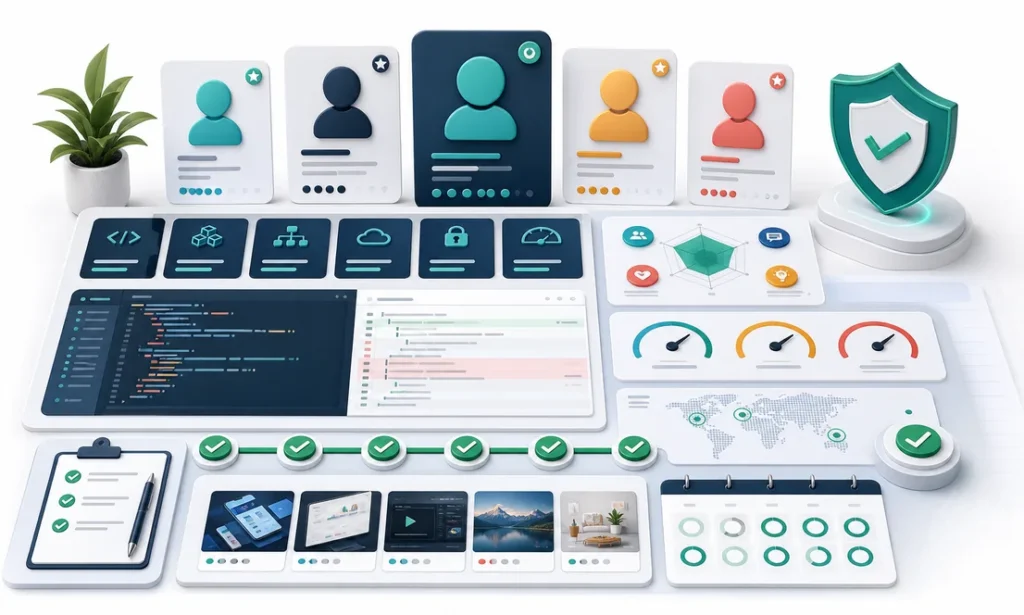
Learning to vet nearshore development team candidates properly is the highest-leverage hour you will spend on your entire outsourcing decision. The rates from Mexico are genuinely attractive — 40 to 60% below U.S. equivalents — but a bad partner at half price is still twice as expensive as no partner at all. As someone who runs a nearshore firm, I will tell you exactly what to check, including the questions I would ask a company like mine. Here are 15 points, ranked by how much pain each one prevents.
How to vet nearshore development team candidates: 15 points ranked by impact
1. Interview the actual people who will write your code
Why it matters: the classic failure mode is being sold by impressive senior engineers and staffed with juniors you never met. Insist on interviewing the specific developers assigned to your project, and get their continuity in writing.
2. Review real code, not a portfolio
Why it matters: screenshots prove nothing. Ask for a repository sample, an open-source contribution, or run a paid technical exercise. Twenty minutes reading their code tells you more than twenty slides.
3. Call current U.S. clients — not the curated list only
Why it matters: references chosen by the vendor are marketing. Ask for a client whose project resembles yours in size and stack, and ask that client one question above all: “Would you sign with them again?”
4. Run a paid pilot before any long commitment
Why it matters: a two-to-four-week paid pilot on a real, bounded deliverable is the cheapest truth serum available. It reveals communication habits, estimate accuracy, and code quality under actual conditions. Any vendor who resists a pilot is telling you something.
5. Verify time zone overlap in practice, not on paper
Why it matters: “aligned time zones” should mean six-plus hours of shared core time. Mexico-based teams working U.S. Central hours deliver this naturally; verify the team’s real schedule, including their meeting attendance expectations.
6. Test English where it counts: in a working session
Why it matters: polished sales English is not engineering English. Put the actual developers in a technical discussion and watch whether they ask clarifying questions, push back, and explain trade-offs. Silence in a requirements meeting becomes rework in your codebase.
7. Get IP ownership and confidentiality in writing, under enforceable terms
Why it matters: your contract should state plainly that all work product belongs to you, with NDAs signed by the company and the individuals. Mexico’s USMCA framework gives U.S. companies solid legal footing — but only if the paperwork exists.
8. Ask for their staff retention numbers
Why it matters: nearshore turnover is the silent project killer. A firm that retains engineers for years transfers knowledge into your product; a revolving door transfers your budget into onboarding. Ask directly: what was your developer turnover last year?
9. Examine the seniority mix on your team
Why it matters: an all-junior team at a great rate is how projects quietly fail. You want senior leadership on architecture with a sensible mix underneath — and the ratio disclosed up front, per role, per rate.
10. Demand process transparency: sprints, demos, and metrics
Why it matters: you should see working software every one to two weeks, not status reports. Ask how they run sprints, what you see at each demo, and which metrics they report without being asked.
11. Check security practices like you mean it
Why it matters: access controls, device policies, code repository permissions, and how credentials are handled. One careless contractor with production keys is an incident waiting for a date.
12. Probe domain experience with your kind of problem
Why it matters: a team that has built logistics, manufacturing, or fintech systems before yours starts weeks ahead on vocabulary alone. Domain familiarity is a discount no rate card shows.
13. Get pricing clarity, including what is not included
Why it matters: the gap between vendors is rarely the rate; it is what the rate covers. Project management? QA? Meetings? Ask for a sample invoice from a real engagement.
14. Understand their tooling and how it meshes with yours
Why it matters: if they cannot work inside your repos, CI pipeline, and communication channels from day one, you are not extending your team — you are managing a separate company.
15. Negotiate the exit before the entrance
Why it matters: notice periods, code handover, documentation obligations, and knowledge-transfer sessions belong in the contract while everyone is still friendly. The quality of a vendor shows most clearly in how they let you leave.
Where to start
If the full list feels heavy, run points 1, 3, and 4 first: interview the real team, call a real client, and pay for a real pilot. Those three catch the majority of bad outcomes for a few thousand dollars and a couple of weeks. Then use the remaining twelve as your contract checklist before signing anything long-term. For a deeper look at what a healthy engagement is supposed to feel like, see our guide to choosing a nearshore software development partner, and how we structure nearshore software development engagements from Mexico for U.S. teams.
One closing note from the other side of the table: a serious firm will welcome every item on this list, because the same checklist that helps you vet nearshore development team options is the one that filters out the competitors who make our industry look bad. If a vendor bristles at scrutiny, you have your answer early — and early is the cheapest time to get it.
Want to put us through this exact checklist? Schedule a call — bring the list, we’ll bring the answers.
Finding this analysis useful?
Get one email a week with the most important developments in AI and business technology — explained in plain English, with real numbers and zero spam.
Want this working in your business?
Book a free 30-minute session: we look at your case and tell you what is worth doing (and what is not) — no strings, no sales pitch.
Book a free session →