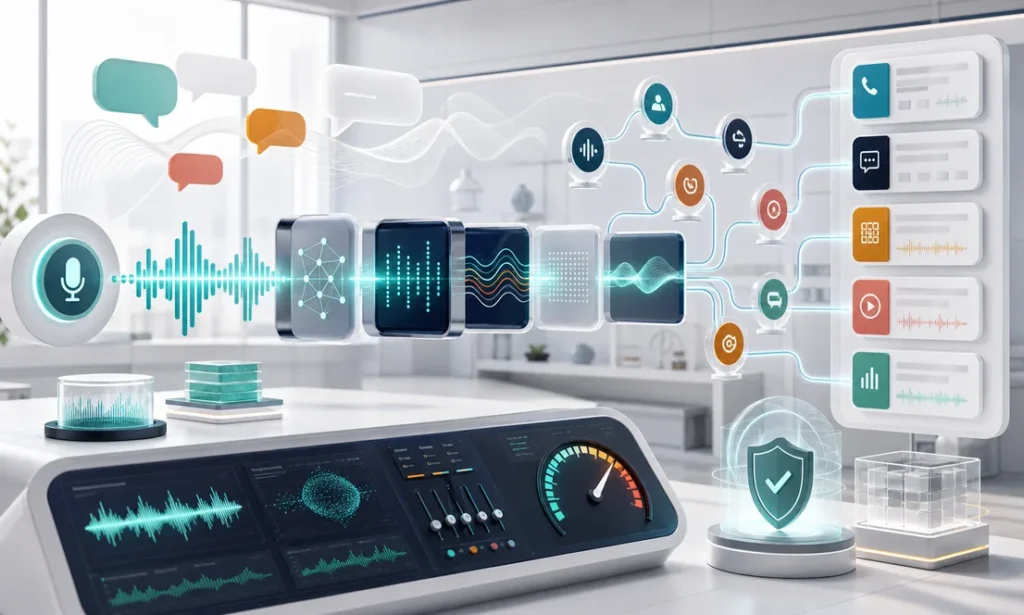
On July 8, 2026, OpenAI launched GPT-Live, a new generation of voice models that breaks something we all took for granted: turn-taking. Until now, you talked to an assistant, went quiet, waited, and it replied. GPT-Live listens and speaks at the same time, like a person does. You can cut it off mid-sentence and it adjusts, or have it translate a live call while both people keep talking. For a business owner, this isn’t a tech toy. It’s the gap between a phone bot that sounds like a robot and one a customer never realizes isn’t human.
The 60-second summary
- What it is: GPT-Live is OpenAI’s family of “full-duplex” voice models. Full-duplex means it can listen and speak at the same time, not in turns.
- When: announced July 8, 2026, and rolled out to ChatGPT users that same week.
- Two versions: GPT-Live-1 mini, which replaces Advanced Voice Mode by default, and GPT-Live-1, the larger model for paid tiers.
- What’s genuinely new: it handles interruptions naturally and does live translation between languages while the conversation keeps flowing.
- Not in the API yet: at launch it lives inside the ChatGPT app; developer access is waitlisted. That matters for when you can wire it into your phone system or chat.
What actually changed: voice stops being a walkie-talkie
Think about how you talked to Siri, Alexa, or ChatGPT’s old Voice Mode until yesterday: a walkie-talkie. You talk, release the button, it talks. The model decided you were done by detecting silence. The flaw is obvious to anyone who has fought a phone menu: a pause to think, background noise, or an “uhh” and the system either cut you off or went dead.
GPT-Live swaps the engine. Instead of waiting for silence, it makes decisions many times per second: speak, keep listening, pause, interrupt, or call a tool. That’s why you can cut it off mid-answer —”no, wait, make it the 5 o’clock one”— and it adjusts without stumbling. It’s the difference between a receptionist who lets you finish and one who talks over every sentence.
The other strong piece is live translation: because it listens and speaks at once, it can translate a two-language conversation in near real time. For a border operation serving customers in English and Spanish, that stops being science fiction.
GPT-Live vs. the old voice mode
| Feature | Turn-based voice (through 2026) | GPT-Live (Jul 2026) |
|---|---|---|
| Architecture | Half-duplex: talk or listen | Full-duplex: talk and listen at once |
| Interruptions | Clumsy; silence marks the turn | Natural; decides many times per second |
| Translation | Chunked, with pauses | Live, while the conversation flows |
| Versions | Single voice mode | GPT-Live-1 and GPT-Live-1 mini |
| Where it lives today | ChatGPT app | ChatGPT app (API waitlisted) |
What does this mean for your business?
In a free 30-minute session we'll show you how to put technology like this to work in your operation — no hype, real numbers, concrete steps.
The data, minus the hype: what it really means
OpenAI tested these models on multi-turn customer support tasks (a benchmark called tau3-Voice, aimed at telecom-style support). In business terms: they didn’t just build it to chat, they measured it resolving the kind of call your company gets every day —”I want to move my appointment,” “my order never arrived,” “what’s my balance?”
Now the honest read, so nobody sells you smoke:
- The accent still gives it away. Outside English it can sound accented or lose fluency. Test it in your own language and register before it fronts your customers.
- No public API yet. Working inside ChatGPT is not the same as wiring it into your phone system or chat. That comes when developer access opens.
- It doesn’t replace your process. A natural voice giving wrong information is worse than a boring menu giving the right one. Quality depends on the data you connect to it.
What it means for a small or midsize business
Voice is the channel where people push back hardest on bots —they hang up the second they hear a robot. An assistant that actually converses changes the math on three concrete fronts:
- Phone support that doesn’t get hung up on. A full-duplex assistant can take the call, handle interruptions, and book or resolve without sounding like a recording.
- Bilingual operations. If you serve customers across the US–Mexico line, live translation lowers the language barrier in both sales and support.
- A front desk that never sleeps. Clinics, shops, real estate: a big share of calls land after hours. A voice that confirms appointments at 9 p.m. is booked revenue you weren’t capturing.
None of this removes the need for a clean process behind it. A voice assistant is only as good as the system it’s connected to: your calendar, inventory, CRM. So the real question isn’t “should I turn on GPT-Live?” but “is my operation ready for an AI to speak on behalf of my business?”
How to decide without betting blind
- Listen to it yourself first. Open voice mode in the ChatGPT app and hold a real conversation. Does it sound like your business or like an accented robot? That’s your acid test.
- Pick one use case. Appointment confirmations, or basic quotes, or FAQs. One. A small measured pilot beats dreaming about replacing the call center.
- Wait for the API for anything serious. Connecting voice to your phone line or CRM needs developer access. Meanwhile, get the part that depends on you ready: clean data and a clear process.
- Compare it to what you already have. A solid chat flow can resolve most questions today without waiting on voice. Voice adds value where chat falls short.
FAQ
Can GPT-Live answer my business phone yet?
Not directly. At launch it lives inside the ChatGPT app. Wiring it into a phone line or chat needs the API, which as of July 8, 2026 was waitlisted for developers.
How well does it handle non-English languages?
It’s optimized for the most-used languages, but outside English it can carry an accent or lose fluency. Test it with your own script before exposing it to customers.
How is it different from a chat assistant?
Chat is text; GPT-Live is real-time voice. They don’t compete: many businesses resolve written questions in chat and reserve voice for calls where the customer prefers to talk. Understanding what AI agents can actually do for a business helps decide which comes first.
What does it cost?
The mini version reaches ChatGPT users by default and GPT-Live-1 goes to paid tiers. API pricing to embed it in your business wasn’t published at launch; it will depend on when developer access opens.
Finding this analysis useful?
Get one email a week with the most important developments in AI and business technology — explained in plain English, with real numbers and zero spam.
Sources
- OpenAI — Introducing GPT-Live
- TechCrunch — OpenAI releases new voice models (Jul 8, 2026)
- BuildFastWithAI — GPT-Live Review (Jul 2026)
At Azterion we help companies put AI to work in their real operations —chat, voice, and automation— without the hype. If you want to know which use case to tackle first, schedule a discovery call and we’ll review it against your numbers.
