Adding an AI chatbot for website visitors went from novelty to table stakes fast: buyers now expect an instant, competent answer at 9 p.m. on a Sunday, and a growing share of them will simply move to the next tab if they don’t get one. The good news is that 2026-era chatbots are genuinely useful — nothing like the “I didn’t understand that” decision trees of five years ago. The bad news is that most implementations still disappoint, because companies buy the widget and skip the work that makes it smart. Here is what it actually takes.
What a modern AI chatbot for website visitors can really do
Today’s bots are built on large language models, which means they understand questions as humans ask them — typos, slang, three questions in one sentence. Connected to your content and systems, a well-built bot can answer product and pricing questions from your actual documentation, qualify leads by asking the same questions your sales team would, book appointments directly onto a calendar, check order or ticket status by looking into your systems, and hand off to a human with full context when the conversation crosses a line you defined. The realistic performance bar in 2026: handling 60-80% of routine inquiries without human help. Vendors claiming 95% are measuring something friendlier than reality.
The three ingredients (and the one everyone skips)
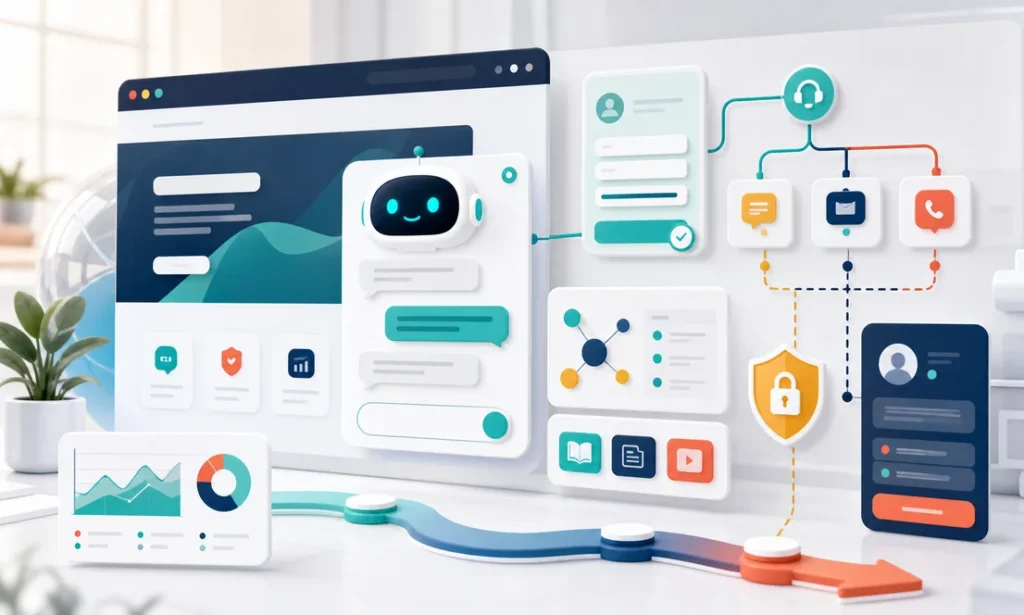
Every effective website chatbot has three layers. The model — the language engine itself, which you rent per usage; it supplies fluency, not knowledge of your business. The knowledge layer — your FAQs, product docs, policies, and pricing, organized so the bot retrieves the right passage and answers from it instead of improvising. The guardrails — rules for what the bot must not do: quote custom prices, give legal or medical advice, promise delivery dates, or bluff when unsure. The knowledge layer is the one everyone skips, and it is the difference between a bot that quotes your actual return policy and one that invents a generous new one. Plan on spending more hours curating content than configuring software; that ratio is normal and correct.
What it costs in 2026
Three realistic tiers. Off-the-shelf SaaS bots run $30-$500 a month depending on conversation volume, and setup is measured in days — right for FAQ-style support on standard websites. Mid-tier platforms with CRM integrations, lead routing, and customization run $500-$2,000 a month plus a $2,000-$10,000 setup engagement. Custom-built assistants — trained on your knowledge base, wired into your inventory, booking, or quoting systems, speaking in your brand voice — typically cost $10,000-$40,000 to build with a nearshore team (roughly 40-60% below equivalent US agency pricing) plus $200-$800 a month in model usage and hosting. The tier you need tracks one variable: how much of the bot’s value depends on your systems rather than your documents. Answers-from-documents is cheap; actions-in-systems is where custom work earns its price.
Implementation: the 6-week version that works
Weeks 1-2: pick the top 20 questions from your actual inbox and call logs — not the questions you wish customers asked. Write or clean the source content that answers them. Weeks 3-4: stand up the bot on that content, integrate the one system that matters most (usually calendar or CRM), and define escalation rules: when to offer a human, what context travels with the handoff. Week 5: internal testing with your own staff trying to break it — every company discovers embarrassing answers here, which is precisely the point of doing it before launch. Week 6: launch on a subset of pages, read every transcript daily for two weeks, and fix the gaps. Transcript review is the highest-ROI hour in the whole project: it shows you exactly what customers want and where the bot fumbles. Treat the chatbot as one front door into broader business process automation — the same wiring that lets it check an order status can automate the fulfillment updates behind it.
The failure modes to design against
Four patterns account for most chatbot regret. Hallucination: a bot without a curated knowledge layer will answer confidently and wrongly — guardrails and retrieval fix this, hope does not. The dead-end trap: no clear path to a human turns mild frustration into a lost customer; always offer escape. Stale knowledge: prices and policies change, and an unmaintained bot becomes a liability on a schedule — assign an owner and a monthly review. Privacy sloppiness: conversations contain personal data, so decide retention, and keep payment details out of chat entirely. None of these is exotic; all of them are checkable in a one-hour vendor conversation. If you are evaluating partners for the build, our guide on how to choose a software company gives you the vetting questions that expose weak answers fast.
FAQ: AI chatbot for website
Will a chatbot replace our support staff?
It replaces the repetitive 60-80% — hours, pricing, status checks — and hands your staff the conversations that need judgment. Most companies redeploy time rather than cut it, and response quality rises on both halves.
How long until it pays for itself?
A bot handling 300 conversations a month that would otherwise consume 5 minutes each returns roughly 25 staff-hours monthly. Against a $10,000-$40,000 custom build cost, typical payback lands in 6-18 months — faster when after-hours lead capture adds revenue rather than just savings.
Can it work in Spanish and English?
Yes — modern models are natively multilingual, and for companies serving both sides of the border a bilingual bot is often the single cheapest way to serve a second-language audience well.
Thinking about a chatbot that actually knows your business? Schedule a free consultation and we’ll scope the right tier — honest numbers, no widget-selling.
Finding this analysis useful?
Get one email a week with the most important developments in AI and business technology — explained in plain English, with real numbers and zero spam.
Want this working in your business?
Book a free 30-minute session: we look at your case and tell you what is worth doing (and what is not) — no strings, no sales pitch.
Book a free session →