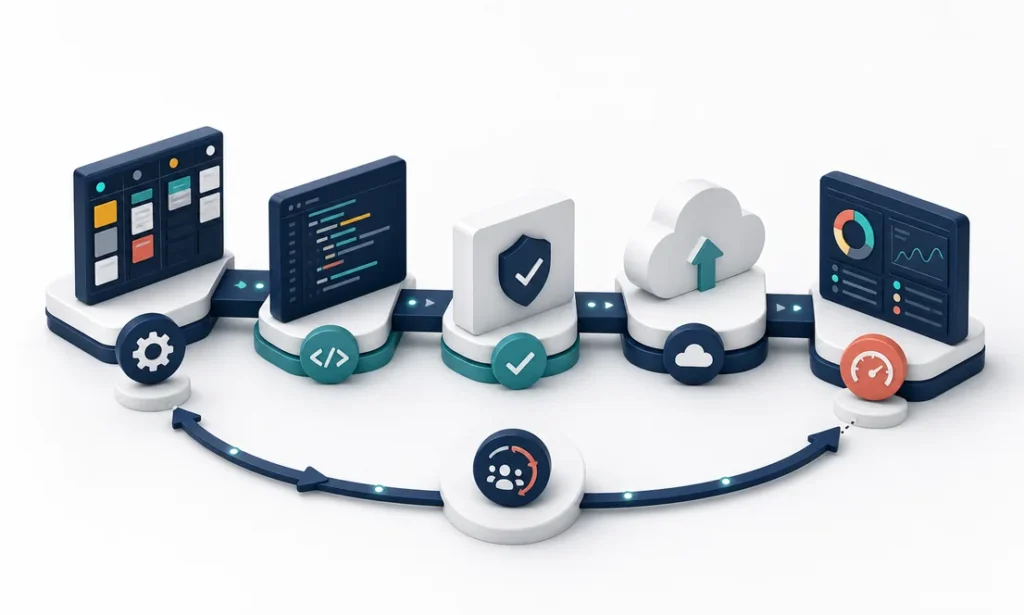
If you have asked a technical person “what is DevOps” and gotten an answer full of pipelines, containers, and Kubernetes, this guide is the translation. DevOps is a way of organizing software work so that building new features and running them reliably are one job instead of two warring departments. For a business owner, it matters for exactly three reasons: software ships faster, breaks less, and costs less to operate. Everything else is implementation detail.
What is DevOps? The restaurant analogy
Picture a restaurant where the chefs invent dishes but never work service, and the waitstaff runs service but never enters the kitchen. Chefs keep launching ambitious plates that fall apart on the way to the table; servers keep getting blamed for it. Now merge them: cooks who plate with the dining room in mind, servers who feed real reactions back to the kitchen, and an expo station that checks every plate before it leaves. Same people, same food — dramatically better nights.
That is DevOps. Traditionally, developers (“Dev”) wrote code and threw it over a wall to operations (“Ops”), who ran the servers and got paged when things broke. Each optimized against the other: developers wanted change, operations wanted stability. DevOps merges the incentive: the people who build it are responsible for how it runs, supported by automation that catches problems before customers do.
The three practices that do the heavy lifting
Continuous integration and delivery (CI/CD). Every code change automatically runs through a battery of tests and, if it passes, can be released within hours instead of quarterly “big bang” launches. Analogy: instead of remodeling your store once a year over a chaotic weekend, you improve one shelf every day while the doors stay open. Small changes are easy to check and easy to undo — which is why teams that release more often actually break things less.
Infrastructure as code. Servers and environments are defined in written, versioned instructions rather than configured by hand. If a server dies, you rebuild it from the recipe in minutes. It is the difference between a franchise operations manual and a restaurant that only works when the founding chef is in the building.
Monitoring and alerting. Dashboards and automatic alarms watch the system’s vital signs, so the team learns about a slowdown from a graph at 2 p.m., not from an angry customer email at 2 a.m. Mature teams measure their reliability and answer for it the way sales answers for quota.
What DevOps means for your P&L
Concretely, four effects. Speed: features move from idea to customer in weeks, not quarters — in competitive markets that is revenue timing. Reliability: less downtime, and faster recovery when something does break; for a business doing $2 million a year through its software, even a 1% availability improvement is real money. Cost: automation replaces the manual babysitting of servers, and right-sized cloud infrastructure routinely trims 20-40% off hosting bills that grew unattended. Risk: releases stop being white-knuckle events, which means your roadmap stops being hostage to fear of deployment. If your team ships quarterly and every release is a fire drill, you are paying a DevOps tax whether or not anyone calls it that.
Do you need to hire a DevOps engineer?
Under roughly five developers, usually not a dedicated one — you need DevOps practices, which a strong senior developer or a fractional specialist can establish in a few focused weeks: pipeline, monitoring, infrastructure recipes. From five to twenty developers, a dedicated platform person starts paying for themselves. US DevOps engineers run $130,000-$180,000 plus benefits, which is steep for a part-time need — one reason mid-market companies increasingly staff the role through nearshore software development teams, getting senior DevOps capability at 40-60% below US rates, on US business hours, often as a fraction of a shared team rather than a full seat. The anti-pattern to avoid: hiring a “DevOps person” and rebuilding the old wall with a new department behind it. DevOps is how your whole engineering function works, not a desk.
How to tell if your current setup has a DevOps problem
Five questions for your next vendor or team meeting. How long does a one-line fix take to reach customers — hours or weeks? Can you release during business hours without holding your breath? If the main server vanished, how long to rebuild — minutes from a recipe, or days of archaeology? Who finds out first when something breaks — your team or your customers? Is there one person whose vacation freezes all releases? Two or more bad answers means the gap is costing you money today. It is also a fixable gap — establishing solid practices on an existing product is typically a 4-8 week engagement, not a rewrite, and it is one of the highest-ROI moves in our technology consulting work.
FAQ: what is DevOps for a business owner
Is DevOps a product I can buy?
No. Vendors sell tools that support it, but DevOps is a working method — like “lean manufacturing,” you can buy equipment that helps, but the practice is how your people operate. Beware proposals that equate a tool purchase with the outcome.
How is DevOps different from agile?
Agile is about deciding what to build in short, feedback-driven cycles. DevOps is about delivering and running it safely at the same pace. They are complementary — agile without DevOps produces software that is planned quickly and shipped slowly.
What does DevOps cost to implement?
For a small product team, expect a focused 4-8 week setup engagement — commonly $15,000-$40,000 nearshore — plus modest monthly tooling costs. Teams typically recover it within the year through lower hosting bills and fewer outage hours.
Want a plain-English read on whether your software operation has a DevOps gap? Schedule a free consultation — twenty minutes, no jargon, real answers.
Finding this analysis useful?
Get one email a week with the most important developments in AI and business technology — explained in plain English, with real numbers and zero spam.
Want this working in your business?
Book a free 30-minute session: we look at your case and tell you what is worth doing (and what is not) — no strings, no sales pitch.
Book a free session →