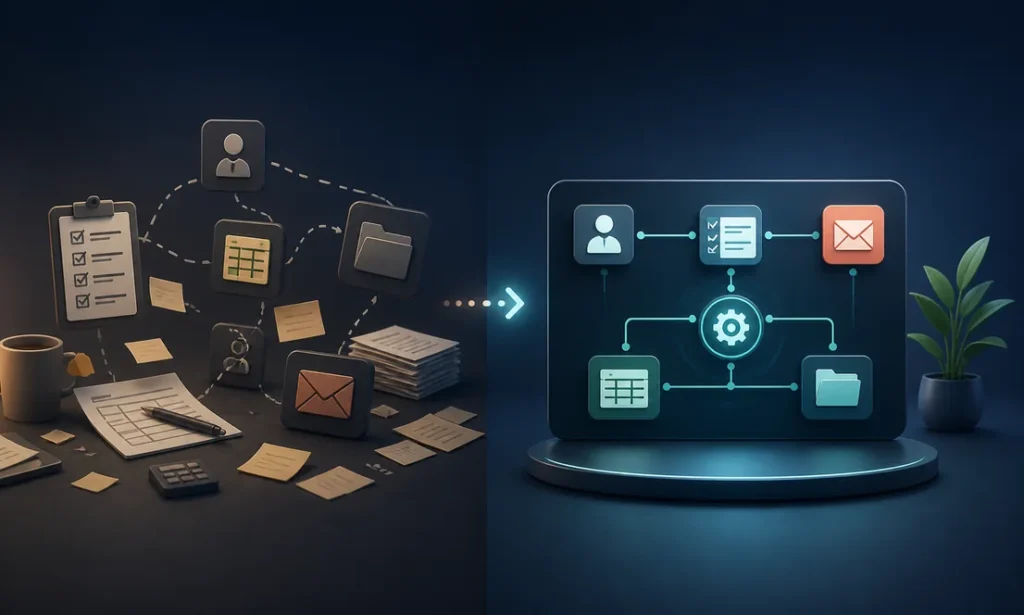
Somewhere along the way, “automation” became a word that makes business owners’ eyes glaze over — it sounds like something for factories or Fortune 500 IT departments. It isn’t. You deserve to have small business automation explained the way you’d explain it to a neighbor over the fence: it is simply teaching software to do the repetitive paperwork your business already does, so your people can do the work that actually requires a person.
Small business automation explained in one sentence
Here it is: automation is any setup where information moves from A to B, or a routine action happens, without a human having to remember to do it. A customer fills out your website form and their info lands in your job board — no retyping. An invoice goes out the moment a job is marked done — no Sunday-night catch-up session. An appointment reminder texts itself the day before — no no-shows because “nobody called them.” That’s the whole concept. Everything else is detail.
What it looks like in a normal week
Think of your business as a series of hand-offs, like a bucket brigade. Every time a bucket passes hands — call to estimate, estimate to job, job to invoice, invoice to payment — there is a chance someone drops it. Automation puts a rail under the buckets. In practice, a typical setup for a service business handles things like: texting back missed calls within seconds, sending quotes and then nudging the ones that go quiet, reminding customers about tomorrow’s appointment, requesting a review after a job closes, and flagging unpaid invoices before they get old. None of these is glamorous. All of them leak money when a human has to remember them.
What it costs, in honest numbers
Two paths, different wallets. Off-the-shelf tools — the subscribe-and-configure kind — typically run $200 to $600 per month per user for the generic platforms. They are fast to start and fine for standard needs. Custom-built automation is a one-time, fixed-price project shaped around your exact workflow, with maintenance typically at 15 to 20 percent of project cost per year; a first working module is usually live in 8 to 12 weeks. Subscriptions rent the solution; custom builds own it. Which is right depends on how unusual your process is and how long you plan to keep it — a good business process automation assessment starts there, not with a product demo.
What automation won’t do
A quick honesty break, because this is where owners get burned. Automation will not fix a process that is broken on paper — it will just execute the broken process faster. It will not close sales for you; it gets the right information in front of a human at the right moment. And it will not “run the business while you fish,” whatever the ads say. What it does is quieter and, frankly, better: it stops the slow leak of dropped hand-offs, forgotten follow-ups, and hours spent retyping things that were already typed once.
How to start without betting the farm
Start with one process — the one that annoys you most or leaks the most money. For most service businesses that is either missed calls or quote follow-up. Automate that single thing, run it for a month, and measure: fewer misses? faster payments? Then take the next one. Owners across Texas take this exact stair-step approach — it is the same path we walk with business automation clients in Dallas — because small wins fund the next win, and nobody has to swallow a giant project on faith.
Where AI fits into all this
You will hear “AI” attached to everything now, so here is the sober version. Most of the value in the small business automation explained above is plain plumbing — information moving reliably between systems, actions firing on schedule. AI adds judgment at specific points along the pipe: answering a caller’s question in natural language, drafting a reply, summarizing a day’s calls. Genuinely useful — but the plumbing comes first. A chatbot bolted onto a business where quotes still live in a shoebox is a doorbell on a house with no floors. Build the floors, then add the doorbell. Many owners report the boring automations out-earn the flashy ones by a wide margin, precisely because they run every single day without applause.
Frequently asked questions
Do I need to be technical to use any of this?
No. If you can describe how a job flows through your shop — who touches it, what gets written down, where it stalls — you have done the hard part. Turning that description into working software is the builder’s job, not yours. The owners who get the best results are the ones who know their own process cold, not the ones who know code.
Will my team resist it?
Some will, at first — usually because they fear it is step one of replacing them. It rarely is. Frame it honestly: the software takes the retyping and the reminders, they keep the judgment calls. Many owners report the same employee who grumbled in week one refuses to give the system up by month three.
What’s the most common first automation?
Missed-call text-back, by a mile. It is cheap, fast to set up, and attacks a painfully visible leak: responding in minutes instead of hours dramatically raises close rates on new leads. It is also a low-risk way to learn how this stuff feels before you automate anything deeper.
If you’d like the concept translated into a concrete plan for your shop, schedule a free consultation — thirty minutes, plain English, no obligation.
Finding this analysis useful?
Get one email a week with the most important developments in AI and business technology — explained in plain English, with real numbers and zero spam.
Want this working in your business?
Book a free 30-minute session: we look at your case and tell you what is worth doing (and what is not) — no strings, no sales pitch.
Book a free session →