The first question we hear from Texas companies considering a development team in Mexico is rarely about code quality. It’s about nearshore security compliance: “How do I know my source code, customer data, and credentials are safe with a team I’ve never met in person?” It’s the right question, and it deserves a better answer than a reassuring smile. The truth is that a distributed team is exactly as secure as the controls you put around it — no more, no less. This guide walks through the framework we recommend: what to demand contractually, what to verify technically, and which red flags should end a conversation early.
Nearshore security compliance: geography is not the risk
Here’s an uncomfortable fact for anyone who equates “offshore” with “risky”: most data breaches involving vendors come from sloppy access management — shared passwords, permissions never revoked, laptops without disk encryption — not from where the vendor sits. A developer in Chihuahua working under SOC 2-aligned controls with scoped access is a smaller risk than an in-house contractor in Dallas with domain admin rights and a sticky note password. Nearshore security compliance isn’t about trusting a country; it’s about verifying a set of practices. The good news: those practices are auditable, and the two-hour drive-or-flight proximity of nearshore means you can literally show up and check.
The legal layer: NDAs, IP assignment, and DPAs that actually hold
Paperwork won’t stop an attack, but it determines who owns what and who’s liable when something goes wrong. Before any code or data changes hands, three documents need to be signed and reviewed by your counsel:
- A mutual NDA with teeth: signed by the company and, ideally, acknowledged individually by each team member assigned to your account. Mexico enforces confidentiality agreements, and a serious nearshore partner will offer US-jurisdiction terms without flinching.
- IP assignment in the master agreement: everything created for you — code, documentation, designs — is your property from the moment it’s written, not upon final payment. “Work for hire” language should be explicit.
- A data processing agreement (DPA) if the team will touch personal data, spelling out what data they can access, where it can be stored, and breach notification timelines. If you’re in healthcare or fintech, this layer expands to HIPAA business associate agreements or your regulator’s equivalent.
Red flag: a vendor who wants to “get started quickly and sort the paperwork later.” Speed is a virtue in sprints, not in contracts.
The technical layer: access control is 80% of the game
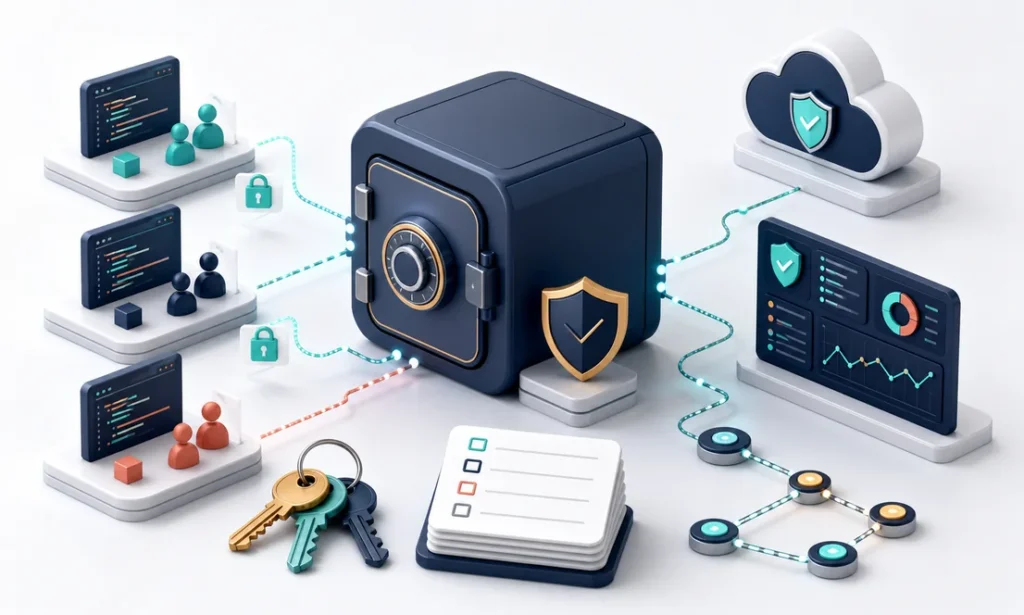
Think of access control like the key system in an office building. Nobody gets a master key; everyone gets a key to exactly the rooms they need, every key is logged, and keys are collected the day someone leaves. Translated to software:
- Least-privilege access: developers get access to the repos and environments they work on — not your whole GitHub organization, and almost never production data. Real customer data stays out of development environments; masked or synthetic data goes in.
- Your systems, your accounts: team members work inside accounts you provision and can revoke in one click — your repo, your cloud, your project tracker. If the code lives only on the vendor’s infrastructure, you don’t have a vendor, you have a hostage situation.
- MFA everywhere, SSO where possible: non-negotiable for repos, cloud consoles, and VPNs.
- Secrets management: credentials live in a vault, never in code, chat, or email. If a vendor sends you a database password over Slack in week one, believe what you just saw.
- Offboarding in hours, not weeks: when a developer rolls off, every access is revoked the same day, and you receive confirmation. Ask a prospective partner to describe this process; the ones who have it answer in specifics.
What SOC 2 actually tells you (and what it doesn’t)
SOC 2 is an independent audit of a company’s controls around security, availability, and confidentiality. A Type II report — the meaningful one — verifies those controls operated over months, not just that they exist on paper. Should you require it? Context matters. Large nearshore firms serving regulated industries should have one. Smaller specialized shops often don’t carry the certification itself (audits cost tens of thousands of dollars) but can operate SOC 2-aligned: documented policies, access reviews, encrypted devices, background checks, incident response plans. What you actually need is evidence, not a logo: ask for their security policy, ask who reviews access and how often, ask what happened the last time something went wrong. A partner who answers those three questions crisply is telling you more than a PDF badge ever will. This is a core part of how we structure nearshore software development engagements — the controls conversation happens before the kickoff, not after an incident.
The human layer: vetting, training, and turnover
Controls are executed by people, so ask about the people. Background checks on hires. Security onboarding for every engineer, not just a PDF nobody reads. Device policies: company-managed laptops, full-disk encryption, screen locks. And critically, turnover: a shop that churns developers every six months is re-running its security onboarding constantly and leaking context every time. One of the structural advantages of IT outsourcing to Mexico is that senior engineers cost 40-60% less than their US equivalents, which lets partners pay well above local market and keep teams stable — and stable teams are secure teams.
Frequently asked questions
Is my IP legally protected in Mexico?
Yes. Mexico is a USMCA signatory with IP protections aligned to US standards, and contracts can be written under Texas jurisdiction. In practice, your strongest protection is structural: your code lives in your repositories, under your accounts, from day one.
Do I need my nearshore partner to be SOC 2 certified?
If you’re in a regulated industry or your enterprise customers require vendor certifications downstream, yes. Otherwise, SOC 2-aligned practices you can verify — access reviews, encryption, offboarding discipline — deliver the substance without the price tag being passed to you.
Who should own the security setup, my team or the vendor?
You own the perimeter: accounts, permissions, and secrets live under your control. The vendor owns compliance with your rules and brings its own device, training, and personnel controls. Any partner who resists that division is asking for more trust than they’ve earned.
Want to see what a security-first nearshore engagement looks like in practice, before you commit to anything? Schedule a call and we’ll walk you through our controls, ask by ask.
Finding this analysis useful?
Get one email a week with the most important developments in AI and business technology — explained in plain English, with real numbers and zero spam.
Want this working in your business?
Book a free 30-minute session: we look at your case and tell you what is worth doing (and what is not) — no strings, no sales pitch.
Book a free session →