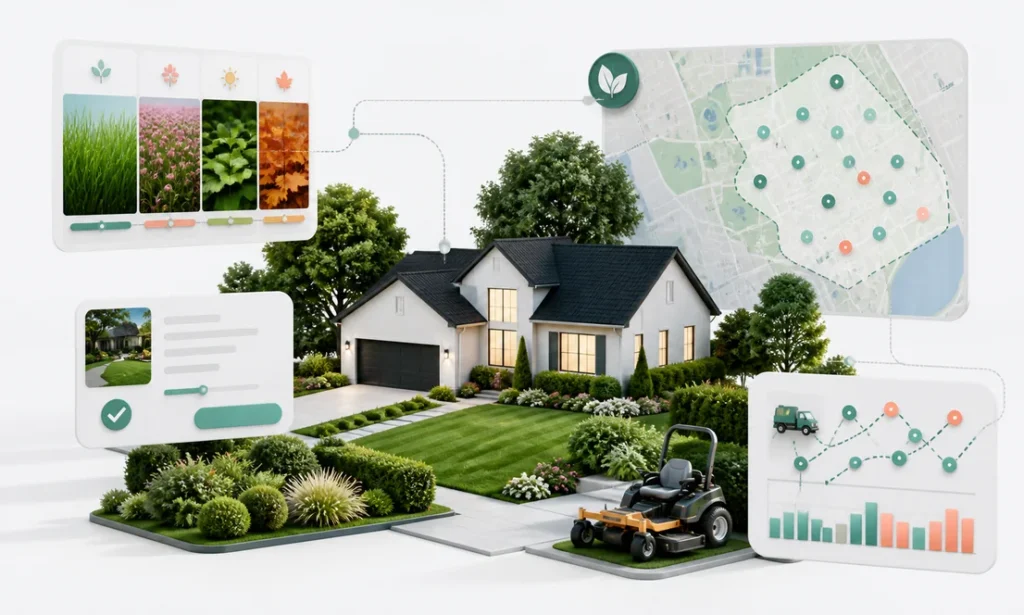
Most advice about marketing for lawn care business owners is written by people who have never priced a route. They talk about followers and branding while you are thinking about drive time between yards and whether your spring rush will cover the winter. This guide starts from how the business actually makes money, because in lawn care and landscaping, marketing that ignores route density and recurring revenue is just expensive noise. Here is the thesis: your marketing should do three things, in this order: win recurring customers, win them close together, and win them before the season starts.
Start with the math your marketing must serve
Think of a route like a garden hose. Every scattered one-time job is a kink in it. A new weekly customer three doors down from an existing one is worth far more than the same customer across town, because the profit is in the minutes between jobs, not just the price of the cut. So before spending a dollar, decide: which neighborhoods do you want to dominate, and what recurring services anchor your revenue? Every campaign below should be aimed at those neighborhoods and those services. This is the difference between buying leads and building a business.
Own your neighborhoods before you own the internet
For a route-based business, hyper-local beats broad every time. The playbook is unglamorous and it works:
- Google Business Profile, fully fed. Photos of real work, services listed, every review answered. This is what a homeowner checks after a neighbor mentions you.
- Reviews on a system. Ask after visible transformations, cleanups, first mows, big installs, automatically, not when you remember.
- Neighborhood presence. Yard signs on install jobs, door hangers on the five houses around every new recurring customer, and a presence in local online groups where homeowners actually ask for recommendations. The message is always the same: we already work on your street.
Paid search has its place, especially for high-ticket landscaping projects, but it should be measured ruthlessly against booked work. That discipline, tying every channel to revenue instead of clicks, is what we mean by data-driven digital marketing, and it matters double in a business with thin per-visit margins.
Sell the contract, not the cut
One-time cleanups pay for the week; agreements pay for the year. Your website, your quotes, and your follow-ups should all lead to recurring plans: weekly or biweekly mowing, seasonal fertilization programs, annual maintenance bundles. When a one-time customer says yes to a cleanup, the follow-up offer for a season plan should be automatic, within days, while your work is still the best-looking yard on the block. Many owners report that simply asking every one-time customer for the recurring upgrade, consistently, does more for revenue than any ad campaign they have run.
Recurring customers also make every other marketing dollar work harder: they raise route density, feed your review engine on a predictable schedule, and give you a real list to email when you add a new service next spring.
Time the calendar, because your customers already do
Marketing for lawn care business owners is a timing game. Homeowners decide on spring services in late winter, on irrigation and hardscape projects ahead of summer, and on cleanups in fall. Your campaigns should land a few weeks before each decision window: pre-season signup pushes in February and March, project promotions in late spring, aeration and cleanup offers as leaves turn. Off-season is not for silence; it is for booking next season with early-signup incentives while your competitors hibernate. A simple annual marketing calendar, written once and reused, beats improvising every year.
Where marketing for lawn care business budgets get wasted
Three budget leaks show up over and over. First, shared lead platforms that sell the same homeowner to four companies; you pay to race strangers to a phone. Second, broad ads with no geographic focus, which win you kinked-hose customers an hour apart. Third, slow follow-up: a quote request answered the next day is often already lost, because responding in minutes rather than hours dramatically raises close rates. If you fix only the third one, automatic instant responses to every inquiry, you will likely feel it in bookings before you spend anything new. And a note on agencies: US firms typically charge $2,500-$10,000 per month in retainers, which is hard to justify for a solo crew. A nearshore team like ours at Azterion runs 40-60% below typical US rates, and our marketing team serving El Paso works with exactly this kind of local service business. When you are small, though, the honest answer may be: do the neighborhood basics yourself first.
FAQ
How much should a lawn care company spend on marketing?
There is no magic percentage. Start from capacity: how many new recurring customers can you actually serve in your target neighborhoods? Fund the channels that historically produce them, measure cost per new contract, and stop paying for anything that cannot show its number.
Is social media worth it for lawn care?
As a portfolio and proof, yes; before-and-after photos travel well in local groups. As a paid acquisition channel, usually only after your Google presence, reviews, and follow-up speed are already strong.
When does hiring an agency make sense?
When you have proven demand, defined routes, and more inquiries than time, and the owner is the bottleneck. An agency multiplies a working system; it rarely rescues a missing one.
Want a marketing plan built around your routes and your season, not someone else’s template? Schedule a free call and we will build the calendar with you.
Finding this analysis useful?
Get one email a week with the most important developments in AI and business technology — explained in plain English, with real numbers and zero spam.
Want this working in your business?
Book a free 30-minute session: we look at your case and tell you what is worth doing (and what is not) — no strings, no sales pitch.
Book a free session →