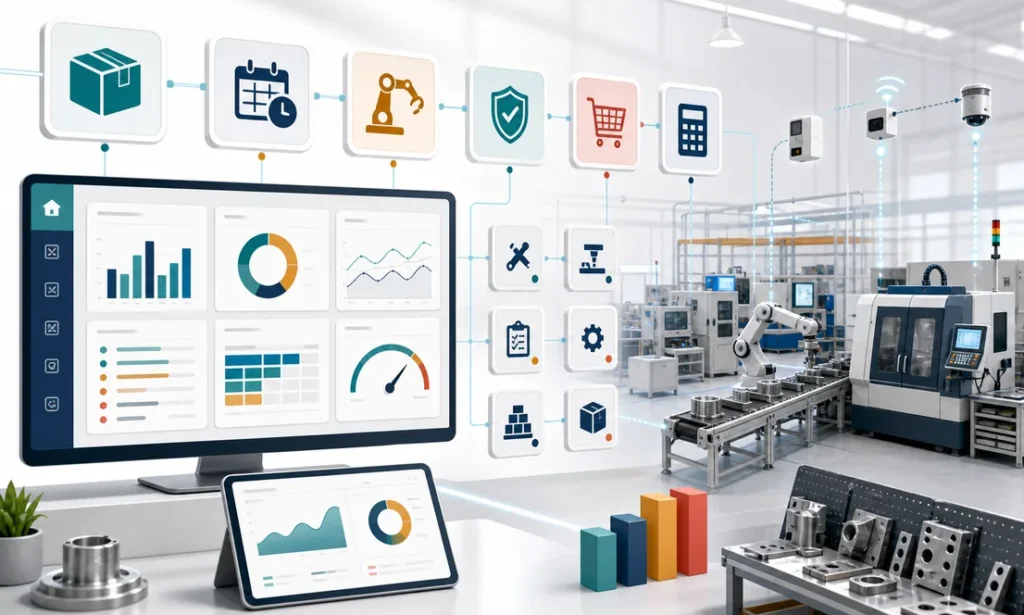
Shopping for an ERP for small business manufacturing is uniquely frustrating: the big-name systems are priced and staffed for companies ten times your size, while the small-business tools are built for retailers and consultants who have never seen a bill of materials. A 20-to-100-person shop lives in the gap. This guide covers what actually matters for a small manufacturer, what realistic budgets look like, and when the right answer is not a bigger package but a system shaped to your floor.
What a small manufacturer actually needs
Strip away the feature-list theater and manufacturing ERP comes down to five jobs:
- Bills of materials and routing: multi-level BOMs that survive engineering changes without a week of re-keying.
- Inventory with lot and location tracking: raw materials, WIP, and finished goods you can trust — including traceability if you ever face a recall or an audit.
- Production scheduling: what runs on which machine, in what order, and what happens when a rush order lands on Tuesday.
- Job costing: what each unit really cost — materials, labor, scrap — versus what you quoted. This is the number that quietly decides whether you are profitable.
- Purchasing tied to demand: reorder points driven by actual consumption, not by whoever walks past an empty shelf.
Everything else — CRM modules, HR add-ons, dashboards for meetings you do not hold — is negotiable. These five are not.
Features that matter more than the demo suggests
Demos are theater; month three is real life. Every system looks clean when a sales engineer drives it with rehearsed data — the question is what happens when your second-shift lead uses it at 11 p.m. with a rush order on the floor. Three unglamorous things separate systems people use from systems people route around. Shop-floor usability: if logging production takes eleven clicks on a screen designed for accountants, operators will keep their paper travelers, and your data will be fiction. Integration: the ERP must connect cleanly to your accounting system, and ideally to your quoting or e-commerce tools — swivel-chair data entry between systems is where errors breed. Reporting you can change yourself: if every new report means a consultant invoice, you will stop asking questions, which defeats the point of owning the data. And a fourth, for anyone selling into regulated or big-brand supply chains: audit-ready records — lot traceability, quality checkpoints, and change history you can produce in an afternoon, because customer audits do not reschedule themselves around your filing system.
What an ERP for small business manufacturing really costs
Realistic 2026 numbers for a small manufacturer, in U.S. dollars — and note that the sticker price is the smallest of the three lines:
- Cloud manufacturing ERP subscriptions: roughly $100–$300 per user per month for the mid-market tier. A 15-user shop should expect $20,000–$50,000 per year in licenses alone.
- Implementation: the routinely underestimated line. Data migration, configuration, and training typically run $15,000–$75,000 — often 1–2 times the first year of licenses.
- The long tail: customizations, added modules, and annual price increases. Budget 15–20% of the initial cost per year, every year.
The pattern to avoid is paying enterprise-grade money for a system your team uses at 30% capacity while the workflows that make you money still live in spreadsheets on the side. Those side spreadsheets are not free either — we broke down their real price in the hidden costs of running operations on spreadsheets.
Off-the-shelf, custom, or both
The honest decision framework: if a standard manufacturing ERP fits 80% of how you work and you can live with changing the other 20%, buy it — never build what you can rent adequately. The test is whether that last 20% is preference or profit: changing which report prints first is preference; changing how you cost custom jobs can be the margin itself. But small manufacturers often win business precisely because of an unusual process — custom fabrication, odd units of measure, customer-specific quality paperwork — and forcing that uniqueness into a generic package means either expensive per-hour customization of someone else’s product or slow death by work-around.
The middle path many shops land on: a solid accounting core plus targeted custom software development for the pieces that make you different — a quoting engine that knows your real costs, a shop-floor tracking app your operators actually use, a scheduling board built around your machines. A focused custom module typically runs $30,000–$80,000 built nearshore, with senior developers at $4,500–$8,000 per month rather than $12,000–$18,000 U.S. — and it earns its keep by fitting your process instead of renting you someone else’s.
Frequently asked questions
How long does an ERP for small business manufacturing take to implement?
Plan on four to nine months from signing to stable daily use for a full package — data cleanup and training, not software installation, consume most of it. A focused custom module is faster: a first working version in 8–12 weeks, precisely because the scope is only the part you need.
We run on spreadsheets today. Are we ready for an ERP?
Spreadsheets are actually a good sign: they document your real process. You are ready when the spreadsheets start failing you — version confusion, one person who “owns” the file, inventory counts nobody believes. Bring those spreadsheets to the selection process; they are your requirements document in disguise.
If you are weighing a package against building the parts that make you different, schedule a free 30-minute call — we will give you a straight answer, even if it is “buy the package.”
Finding this analysis useful?
Get one email a week with the most important developments in AI and business technology — explained in plain English, with real numbers and zero spam.
Want this working in your business?
Book a free 30-minute session: we look at your case and tell you what is worth doing (and what is not) — no strings, no sales pitch.
Book a free session →