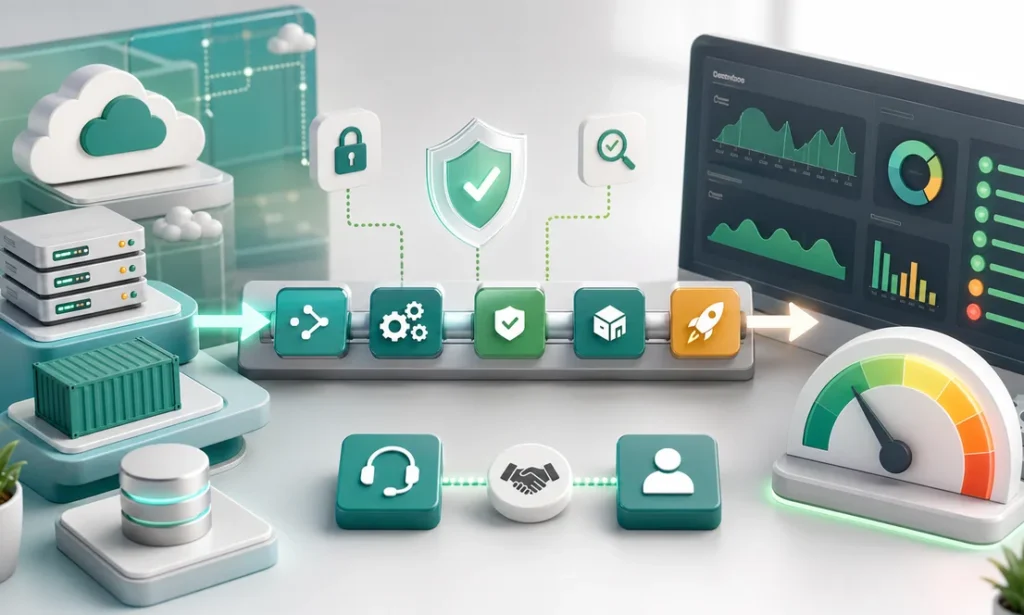
Every growing software company hits the same wall: the product works, customers keep signing up, and the developers are suddenly spending more time on servers, pipelines, and 2 a.m. alerts than on the product itself. DevOps outsourcing exists for exactly this moment — handing infrastructure, deployments, and reliability to an outside team so your engineers can get back to building. Done right, it is one of the highest-leverage outsourcing moves a company can make. Done casually, it hands the keys to production to strangers. Here is what it covers, what it costs in 2026, and when it actually pays.
What DevOps outsourcing actually covers
DevOps is not one job; it is a bundle of them. A serious outsourced engagement typically includes:
- CI/CD pipelines: automated build, test, and deployment, so releases become boring instead of scary.
- Cloud infrastructure: AWS, Azure, or Google Cloud environments defined as code, so nothing depends on what one administrator happens to remember.
- Monitoring and alerting: knowing something broke before your customers tell you.
- Security and backups: patching, access control, and recovery that has actually been tested — not assumed.
- Cost optimization: trimming the 20–35% of cloud spend most companies waste on idle or oversized resources.
Think of it as hiring a building superintendent for your software. When the work is done well, you stop noticing it — and that is the point.
What DevOps outsourcing costs in 2026
A full-time U.S. DevOps engineer runs $130,000–$180,000 a year in salary — roughly $12,000–$18,000 per month once benefits and overhead are added, the same fully loaded range as any senior U.S. engineer. Most companies under 50 employees simply do not have 40 hours a week of DevOps work to justify that. The realistic options:
- Project-based: a defined engagement — pipeline setup, a cloud migration, a monitoring rollout — typically $10,000–$40,000 depending on complexity.
- Fractional retainer: ongoing maintenance, patching, and incident response for a fixed monthly fee, usually $2,500–$6,000 depending on the size of the environment.
- Dedicated nearshore engineer: a full-time DevOps engineer embedded in your team at $4,500–$8,000 per month — 40–60% below the U.S. equivalent, working your business hours from Mexico.
When it pays
The signals are remarkably consistent from company to company:
- Developers spend more than 15–20% of their week on infrastructure instead of features. At senior salaries, that is the most expensive server administration money can buy.
- Deployments are rare, manual, and stressful — a Friday release feels like a gamble nobody wants to take.
- The cloud bill grows every month and nobody can explain exactly why.
- A customer or auditor just asked about SOC 2, backups, or disaster recovery, and the honest answer was a shrug.
If two or more of those sound familiar, outsourced DevOps usually pays for itself within a quarter — in recovered developer time alone, before you count reduced downtime or cloud savings.
The math is worth doing explicitly. Two developers each losing eight hours a week to infrastructure work represents roughly $6,000–$9,000 per month of senior payroll spent on tasks a specialist handles faster and better. Replace that with a $2,500–$6,000 retainer and you have not added a cost — you have swapped an expensive, distracted generalist hour for a cheaper, focused specialist hour, and gotten your feature velocity back in the same move.
When it does not
Skip it if your entire product runs comfortably on a managed platform, deployments already take minutes, and downtime would annoy rather than devastate you — a consultant reviewing your setup twice a year may be all you need. Skip it, too, if what you actually need is one big one-time fix; buy that as a project, not a retainer, and revisit the ongoing question afterward. And skip any provider you are not willing to give real access and real context. DevOps outsourcing fails when the provider is treated like a vending machine instead of a teammate.
Finding this analysis useful?
Get one email a week with the most important developments in AI and business technology — explained in plain English, with real numbers and zero spam.
How to choose a partner
Three filters do most of the work. First, time zone: infrastructure emergencies do not wait twelve hours for another continent to wake up, which is why U.S. companies increasingly choose nearshore teams that share their business day. Second, documentation as a deliverable: insist on runbooks, architecture diagrams, and infrastructure-as-code stored in repositories you own, so no knowledge is ever held hostage. Third, engagement fit: if you need a person inside your team, nearshore staff augmentation gets you a dedicated engineer without fighting the U.S. hiring market; if you need infrastructure handled alongside feature work, a broader nearshore software development engagement bundles both under one roof.
Frequently asked questions
Is DevOps outsourcing safe?
For most small and mid-sized companies, it is safer than the status quo — which is usually one overworked developer and a set of backups nobody has ever restored. The safeguards are contractual and technical: least-privilege access, your ownership of every cloud account and repository, and audit logs on every change.
How fast does an outsourced engineer start delivering?
For a typical environment: a two-week assessment, quick wins like monitoring, backups, and pipeline fixes within the first month, and a stable steady state by month two or three.
Do we lose control of our infrastructure?
Only if you sign a bad contract. Accounts, code, and documentation should live under your ownership from day one, so you could change providers tomorrow without starting over. Any partner who resists that structure is telling you something important.
If your developers are firefighting instead of shipping, schedule a free 30-minute call and we will tell you honestly whether DevOps outsourcing fits your stage.
Want this working in your business?
Book a free 30-minute session: we look at your case and tell you what is worth doing (and what is not) — no strings, no sales pitch.
Book a free session →