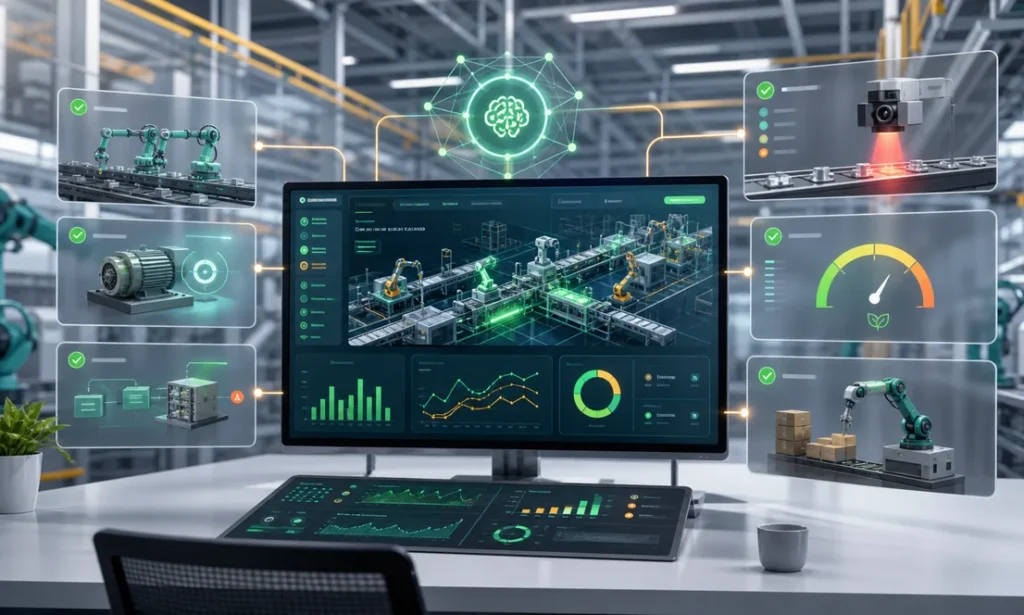
Most of what’s written about AI for manufacturing companies is written for Fortune 500 plants with data science departments. This list is for everyone else — the 50-to-500-employee manufacturers deciding where a first (or second) AI investment actually pays. These seven use cases are ranked by impact for mid-size operations: how fast they return money, how proven the technology is, and how survivable the implementation is without a PhD on staff. The pattern across all seven: AI pays in manufacturing where it removes waiting, waste, or guesswork — not where it’s impressive. And entry costs have dropped far enough that “we’re too small for this” is no longer the safe assumption it was five years ago.
1. Predictive Maintenance
Why it matters: unplanned downtime is the most expensive routine event in any plant — for mid-size operations, each unexpected line stop commonly costs thousands to tens of thousands of dollars per hour once you count idle labor, scrap, and missed shipments. Predictive maintenance uses sensor data (vibration, temperature, current draw) to flag bearings, motors, and pumps weeks before they fail, converting emergency downtime into scheduled maintenance. It ranks first because the ROI math is brutal in the best way: preventing even two or three unplanned stops a year typically covers the system. Entry cost has fallen hard — sensor kits plus monitoring for critical equipment start around $10,000–$50,000, not the millions it took a decade ago.
2. Automated Quality Inspection
Why it matters: human visual inspection fatigues, drifts, and misses — and every defect that escapes costs 10x more than one caught in-line. Camera-based AI inspection now catches surface defects, assembly errors, and dimensional issues at production speed with accuracy that holds steady through hour eight of the shift. Typical systems for one or two inspection points run $25,000–$100,000 installed. It ranks second because the payback is both financial and reputational: scrap drops, but so do the defective units reaching your best customer.
3. Demand Forecasting and Inventory Optimization
Why it matters: cash. Mid-size manufacturers routinely sit on 20–30% more inventory than they need — insurance against forecasting by gut feel — while still stocking out of the items that matter. AI forecasting models trained on your sales history, seasonality, and lead times consistently tighten that buffer, freeing five and six figures of working capital. This is often the smartest first project on the list because it needs no sensors and no line changes: just your historical data and someone who knows how to model it.
4. Production Scheduling Optimization
Why it matters: in most plants, scheduling lives in one person’s head and an Excel file — brilliant until reality changes at 9 a.m. AI-assisted scheduling re-sequences jobs around rush orders, machine downtime, and material delays in minutes instead of a morning, squeezing 10–20% more throughput from the same equipment. It ranks fourth only because it usually requires cleaner operational data than items 1–3; done after them, it compounds their gains.
5. Document and Order Processing Automation
Why it matters: the front office is a factory too. POs, invoices, packing lists, certs, and customs paperwork consume hours of skilled staff time daily, and every re-keyed field is an error waiting to ship. AI document processing reads inconsistent formats and pushes clean data into your ERP, cutting processing time 60–80% for most adopters. At $5,000–$25,000 for a first workflow, it’s frequently the cheapest win on this list — and the one that shows results in weeks, which matters for building internal buy-in.
6. Safety and Compliance Monitoring
Why it matters: one serious incident can erase a year of margin — OSHA’s most-cited violations carry penalties into six figures for repeat offenses, and that’s before insurance, downtime, and the human cost. Computer vision on existing cameras can flag missing PPE, blocked exits, and unsafe forklift-pedestrian interactions in real time. It ranks sixth not because it matters less, but because ROI is probabilistic (you’re buying avoided incidents) — easier to fund once earlier projects have built trust in the technology.
7. Operator Knowledge Capture and AI Copilots
Why it matters: your most experienced machinist retires with 30 years of troubleshooting knowledge that exists nowhere else. AI assistants trained on your manuals, maintenance logs, and captured expertise let a second-year technician ask “Line 3 is throwing this fault — what do I check first?” and get your veteran’s answer. Strategic value is enormous as the skilled-trades gap widens; it ranks last only because it’s the least plug-and-play — the payoff scales with how much knowledge you feed it.
Where AI for Manufacturing Companies Should Start
Every success story in AI for manufacturing companies follows the same sequence: don’t start with technology; start with your most expensive recurring problem. Pull twelve months of numbers on downtime, scrap, expedited freight, and inventory carrying cost — whichever line is biggest points at your first project from the list above. Then pilot small: one line, one workflow, one 90-day window with success defined numerically upfront. Off-the-shelf tools cover the standard cases; when your process is genuinely yours, custom software development connects AI to how your plant actually runs rather than forcing your plant to run like the demo. And if the blocker is engineering capacity rather than ambition, that problem now has a well-worn answer — our guide to hiring software teams between Mexico and Texas covers how manufacturers add senior technical talent at 40–60% below US rates, in your time zone.
Want help ranking these seven against your plant’s actual numbers? Schedule a 30-minute call — bring your downtime and scrap figures, and we’ll bring straight answers.
Finding this analysis useful?
Get one email a week with the most important developments in AI and business technology — explained in plain English, with real numbers and zero spam.
Want this working in your business?
Book a free 30-minute session: we look at your case and tell you what is worth doing (and what is not) — no strings, no sales pitch.
Book a free session →