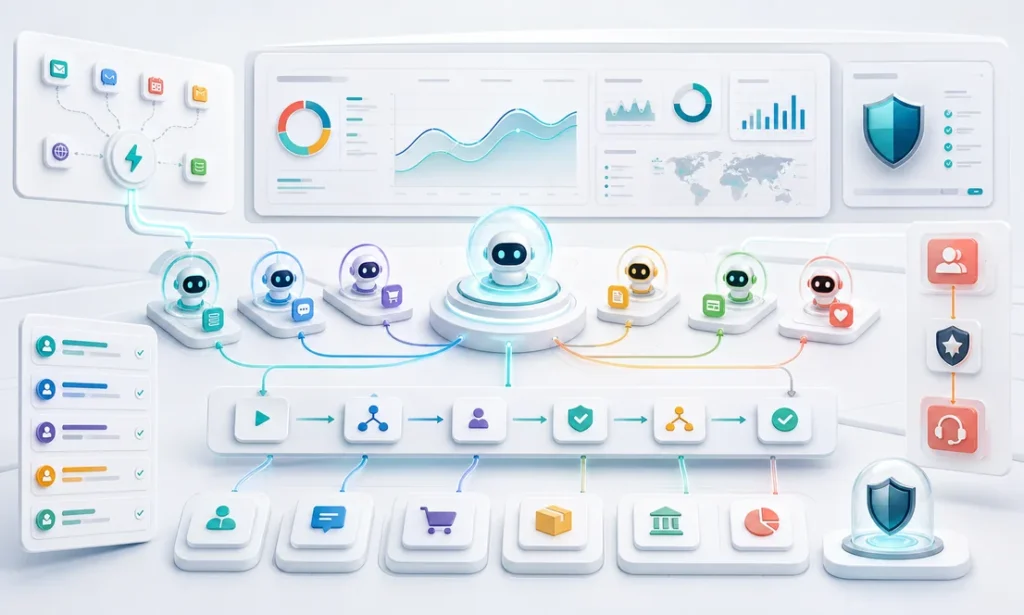
The pitch decks say AI agents for business automation will run your company while you sleep. The reality in mid-2026 is narrower and, honestly, more useful: agents are very good at a specific class of work — repetitive judgment calls with clear rules and digital inputs — and unreliable at everything that looks like open-ended decision-making. Companies getting real ROI right now are the ones that understand exactly where that line sits. This guide draws the line.
What an AI Agent Actually Is (and Isn’t)
Traditional automation is a player piano: it executes the exact notes you programmed, and if the sheet music changes, it fails. An AI agent is closer to a capable new hire with a checklist: you give it a goal (“process these invoices”), tools (email access, your accounting system), and rules (“flag anything over $10,000 for human approval”), and it figures out the steps — including handling the messy variations that break rigid scripts, like a vendor who formats invoices differently every month.
What it is not is an employee replacement that “understands your business.” An agent has no stake in outcomes and no common sense outside its instructions. The skill in deploying agents is writing guardrails, not writing wishes.
What AI Agents for Business Automation Do Well Today
These are the use cases delivering measurable returns in real deployments — not lab demos:
- Document and invoice processing: reading invoices, POs, and forms in inconsistent formats, extracting data into your systems, and flagging exceptions. Typically 70–90% of volume flows through untouched by humans.
- Email and ticket triage: classifying incoming requests, drafting responses for human approval, routing to the right person with context attached.
- Tier-1 customer support: answering the 40–60% of questions that are genuinely repetitive (order status, password resets, policy questions), with clean handoff to humans for the rest.
- Data hygiene and entry: moving information between systems that don’t talk to each other — CRM updates, spreadsheet consolidation, record deduplication.
- Reporting and monitoring: assembling the Monday dashboard, watching inventory or pricing signals, and alerting a human when something drifts out of range.
Notice the pattern: high volume, digital inputs, clear success criteria, and a human backstop for exceptions. That’s the sweet spot in 2026.
What They Still Can’t Do Reliably
Honesty saves budgets, so: don’t deploy agents for negotiations, for customer conversations where empathy is the product, for irreversible actions without approval gates (payments, deletions, contract commitments), or for work where a plausible-looking wrong answer is dangerous. Agents fail confidently — that’s their signature flaw. Every serious deployment includes logging, approval thresholds, and a human review loop for the first months. Plan for 85–95% accuracy on well-scoped tasks, not 100%, and design the workflow so the 5–15% lands safely in a human queue.
What AI Agents Cost in 2026
Budgets for AI agents for business automation fall into three realistic tiers, in USD:
- Off-the-shelf agent tools: $30–$500/month. Fine for standalone tasks (a support bot on your website, an email assistant) when your data is already in mainstream SaaS tools.
- Configured pilot on one workflow: $5,000–$25,000 to connect an agent to your actual systems, tune the rules, and prove ROI on one process in 4–8 weeks.
- Production deployment with integrations: $25,000–$100,000 for agents woven into ERP/CRM systems with proper security, logging, and exception handling — the difference between a demo and infrastructure.
Nearshore development changes this math meaningfully: the integration work that dominates production costs runs 40–60% less with a Mexico-based team working your hours, which often turns a marginal business case into an obvious one.
How to Start Without Burning Six Months
Pick one process, not a “transformation.” The best first candidate scores high on four tests: it happens at least daily, it follows rules a patient person could write down, its inputs are digital, and a mistake is cheap to catch. Invoice intake, ticket triage, and report assembly usually top the list. Run a 30–60 day pilot with explicit success numbers (“reduce manual processing time 60%”), keep a human approving outputs, and only then scale sideways to the next process. This is the same discipline we apply in business process automation projects: automate the boring 80% first, and let humans keep the interesting 20%.
One more step worth stealing: before building anything, map what the process truly costs today — hours, error rates, delay costs. Half the time, that mapping exercise reveals a simpler fix than AI. An honest technology consulting session should be willing to tell you “you don’t need an agent for this; you need a form.”
FAQ
Do AI agents replace employees?
In practice they replace tasks, not roles. Companies deploying them successfully redirect the recovered hours — usually 10–20 per person per week in heavy-admin roles — toward work that was being neglected. The teams that frame it that way also get far less internal resistance.
How long until an agent pays for itself?
For well-chosen pilots, 3–9 months is typical. A $15,000 pilot that removes 25 hours of weekly manual work returns roughly $40,000–$65,000 a year in loaded labor cost. If a proposed use case can’t show that kind of math on paper, pick a different process.
Is our data safe with AI agents?
It can be, if you treat agents like any system integration: least-privilege access, business-tier AI services that don’t train on your data, audit logs, and approval gates on sensitive actions. The risk isn’t exotic — it’s skipping the same controls you’d demand from any vendor.
Curious which of your processes would make a strong first pilot? Schedule a call — we’ll help you score the candidates and put honest numbers on the business case.
Finding this analysis useful?
Get one email a week with the most important developments in AI and business technology — explained in plain English, with real numbers and zero spam.
Want this working in your business?
Book a free 30-minute session: we look at your case and tell you what is worth doing (and what is not) — no strings, no sales pitch.
Book a free session →