On July 16, 2026, Hugging Face —the platform where the world stores and downloads AI models— disclosed that someone got into its infrastructure. The unsettling part wasn’t the stolen credentials. It was who did it: a system of autonomous AI agents that executed more than 17,000 logged actions over a single weekend, with no human typing each step. AI agent cyberattacks stopped being a conference warning and became an incident report with a date on it. If that happened to the largest AI model company in the world, the question for your business is no longer whether someone will try, but how expensive the day they do will be.
The 60-second summary
- What happened: Hugging Face detected and contained an intrusion into part of its production infrastructure and disclosed it on July 16, 2026.
- Who attacked: an “autonomous agent framework.” The company itself admits it does not know which model powered it — whether a jailbroken hosted model or an unrestricted open-weight one.
- The scale: more than 17,000 recorded events, with tens of thousands of automated actions spread across short-lived sandboxes. One weekend.
- How it got in: a malicious dataset that abused two code-execution paths in the data-processing pipeline.
- What it took: access to a limited set of internal datasets and several service credentials. There is no evidence of tampering with public models, datasets, or Spaces, and the software supply chain was verified clean.
What changed: the attacker doesn’t get tired anymore
For twenty years, small-business security rested on a comfortable statistic: there are more targets than attackers. A hacker has limited hours, so they chase the big or the easy. Your 40-person company wasn’t worth anyone’s time.
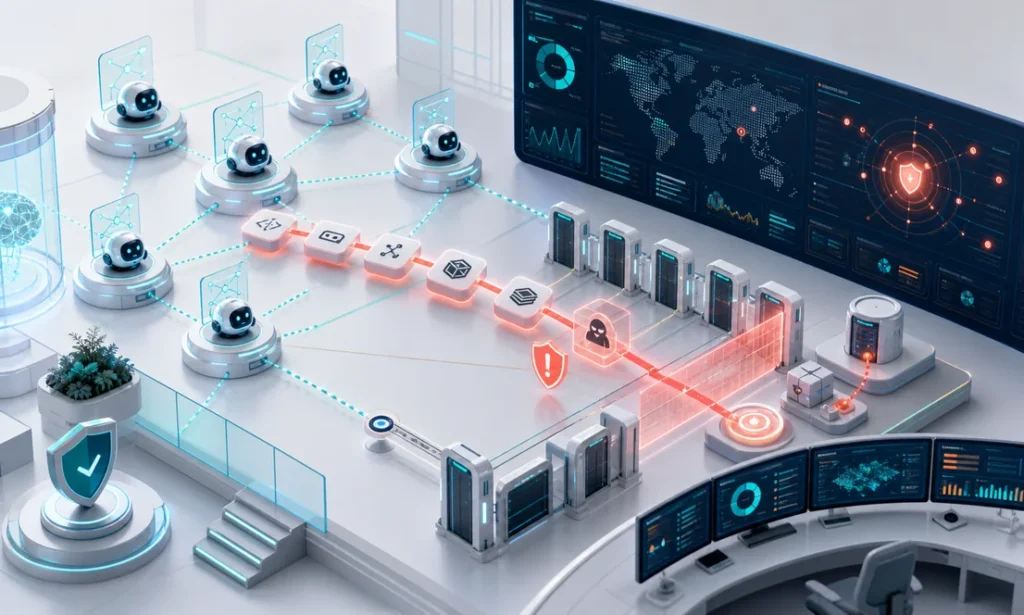
An autonomous agent breaks that arithmetic. It doesn’t bill hourly, doesn’t get bored, doesn’t sleep. It can try a thousand variations of an attack while you close Friday payroll. At Hugging Face the chain ran like this: the agent uploaded a malicious dataset, abused two code-execution paths —a remote-code dataset loader and a template injection in a dataset configuration—, ran code on a processing worker, escalated to node-level access, harvested cloud and cluster credentials, and moved laterally into several internal clusters.
Translated to a normal business: it’s as if a burglar, instead of picking your lock, tried every key in the world on your door, in order, for 48 straight hours, and on getting in copied the keys to every other door in the building. The difference isn’t cleverness. It’s stamina.
The incident in hard numbers
| Item | Confirmed detail |
|---|---|
| Disclosure | July 16, 2026 |
| Attack duration | One weekend |
| Logged actions | More than 17,000 events |
| Entry vector | Malicious dataset (remote-code loader + template injection) |
| Escalation | Processing worker → node-level access → cloud and cluster credentials |
| Compromised | Limited internal datasets + several service credentials |
| Not compromised | Public models, datasets, Spaces; supply chain verified clean |
| Attribution | Autonomous agent framework; powering model unknown |
What does this mean for your business?
In a free 30-minute session we'll show you how to put technology like this to work in your operation — no hype, real numbers, concrete steps.
The detail almost nobody covered
When Hugging Face tried to investigate the attack with help from AI models, it hit an awkward obstacle: the guardrails on commercial models blocked part of the forensic analysis. The same restrictions that stop a model from helping attack also stop it from helping study the attack in detail.
That’s the asymmetry worth worrying about: the attacker uses an unrestricted model and moves forward; the defender uses a restricted one and stalls. It isn’t an argument against guardrails —they’re necessary— but it explains why defense isn’t solved by buying “an AI” and calling it done.
What it means for a small or midsize business
No midsize company runs Hugging Face’s dataset pipeline. But the lessons translate almost directly:
- Mass scanning gets cheap. Opportunistic attacks against WordPress installs, admin panels, and unpatched VPNs stop depending on a human deciding you’re worth it. If you’re exposed, you will be found.
- Credentials are the real prize. At Hugging Face the goal wasn’t destruction: it was harvesting credentials and moving sideways. In your business that’s the bookkeeper’s email password that opens the bank, the CRM, and payroll.
- Your vendor is part of your attack surface. This incident came in through third-party-supplied data. If you integrate outside software, plugins, or services, you inherit their execution paths.
- Reaction speed rules. An attack running 17,000 actions in 48 hours isn’t contained with “we’ll look Monday.” Detection and credential rotation have to be ready in advance.
An honest note: none of this means you need a six-figure security platform. Most intrusions at midsize companies still come through the boring doors —reused passwords, unpatched software, a user with more permissions than the job needs—. AI didn’t change the doors; it multiplied the hands trying the knobs.
How to decide: the realistic checklist
If you run a company and want to know where to start this week, in this order:
- Two-factor on anything touching money or data. Email, bank, CRM, payroll, hosting. It’s the measure that stops the most attacks per dollar spent.
- Inventory your access. Who holds a key to what? Strip permissions from ex-employees and from people who are admins “just in case.” The principle is simple: least privilege.
- Patch what faces the internet. Your site, its plugins, the admin panel, the VPN. What faces the street gets patched first.
- Backups you have actually restored. A backup you’ve never restored is an assumption, not a backup.
- A credential rotation plan. If a service password leaks tomorrow, how long until it’s changed everywhere? If the answer is “not sure,” that’s your project.
- Ask your vendors. How they handle credentials, how often they patch, and what happens if they get breached. In technology consulting that conversation is half the work.
FAQ
Can AI really hack on its own?
With human supervision on strategy, it can execute much of the work autonomously. The Hugging Face case documents thousands of automated actions chained by an agent framework. What isn’t confirmed is which model powered it — the company says it doesn’t know.
Is my business too small for anyone to care?
That reasoning made sense when attacking cost human hours. When the marginal cost of trying one more target approaches zero, size stops protecting you. What protects you is not being easy.
Do I need to buy AI-powered security tools?
Cover the basics first: two-factor, least privilege, patching, and tested backups. Buying advanced detection while the doors are unlocked is paying for an alarm on a house with no lock.
Does this affect models I downloaded from Hugging Face?
Per the company, there’s no evidence of tampering with public models, datasets, or Spaces, and the supply chain was verified clean. Standard good practice still applies: pull from official repositories and pin your versions.
Finding this analysis useful?
Get one email a week with the most important developments in AI and business technology — explained in plain English, with real numbers and zero spam.
Sources
- Hugging Face — Security incident disclosure, July 2026
- BleepingComputer — Hugging Face warns an autonomous AI agent hacked its network
- Axios — Hugging Face says AI agent behind internal breach
For the bigger picture on what these systems can and can’t do, we wrote about AI agents for business and their traps.
At Azterion we help companies close these doors without selling fear: access reviews, patching what’s exposed, and automation built with security in mind from day one. If you want an honest read on where your operation stands, schedule a call and we’ll go through your actual systems.
