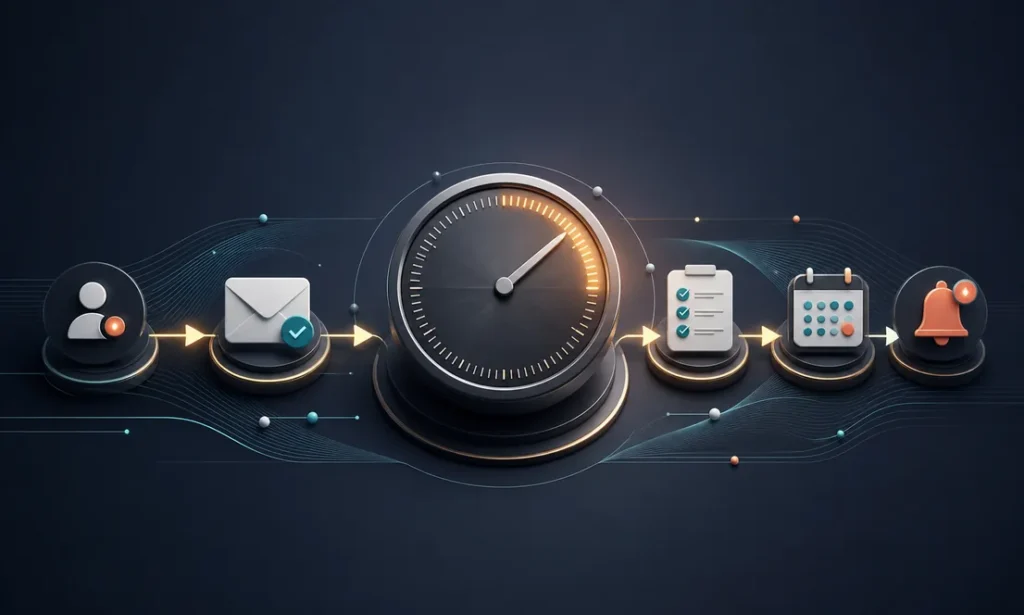
I want to tell you about a service company we worked with — no names, but if you run crews in Texas, you’ll recognize them immediately. Good work, good reviews, steady referrals. And a quiet leak in the business that the owner couldn’t see: leads that went cold before anyone called them back. The fix wasn’t hiring, and it wasn’t more advertising. It was deciding to automate customer follow up so that every inquiry got a response in minutes instead of hours. Here’s the before and the after, told straight.
Before: the “I’ll Call Them Tonight” System
The owner ran estimates all day and did office work at night. Leads came in from everywhere — the website form, Google, phone calls that went to voicemail while he was under a house. His follow-up system was a legal pad on the truck’s passenger seat and a genuine intention to call everyone back after dinner.
You already know what happened. Some nights the calls got made. Some nights a job ran long. Web leads from the morning got a callback at 8 p.m., and a fair number of those people had already booked someone else. Not because the competitor was better — because the competitor answered.
This is the part that stings: speed-to-lead is one of the few things in sales that’s both hugely important and completely controllable. Responding in minutes instead of hours dramatically raises your odds of winning the job, because you’re talking to the customer while the problem is still urgent and before they’ve called anyone else. The owner knew this in his gut. He just couldn’t be in two places at once.
The Turning Point: Admitting the Bottleneck Was the Owner
The conversation that changed things wasn’t about software. It was a question: “What has to happen in the first five minutes after a lead comes in — and does any of it actually require you?”
The answer was humbling. The first five minutes need an acknowledgment, a couple of qualifying questions, and a booked time slot. None of that requires the owner’s twenty years of expertise. His expertise matters at the kitchen table during the estimate — not in the race to say “we got your message.”
That’s the mental shift behind any decision to automate customer follow-up: you’re not replacing the human touch. You’re protecting it, by making sure a human conversation actually happens instead of dying in voicemail.
After: What the 5-Minute-Response System Looks Like
The setup we built was deliberately boring. That’s a compliment — boring systems run forever:
- Instant acknowledgment. Every web form and missed call triggers a text within minutes: “Got your message — a real person will call you shortly. If it’s urgent, reply URGENT.” Simple, human-sounding, honest.
- Qualifying questions by text. The system asks what the customer needs and where they’re located, so when the callback happens, it’s a real conversation, not an interrogation.
- Self-serve booking. Customers who prefer it can grab an estimate slot straight from a link. No phone tag.
- The persistence layer. No response? Polite follow-ups go out over the next few days, then the lead goes into a monthly check-in list instead of a graveyard. Quotes that were sent but not answered get their own gentle sequence.
- The pull cord. Anything unusual — an angry message, a commercial inquiry, a weird request — stops the automation and pings a human immediately.
Notice what’s not in the list: nothing exotic, no AI writing love letters. Just the discipline the owner always wanted, executed by a machine that never has a long day. This is business process automation at its most basic and most valuable — take the repeatable steps off a human’s plate and make them happen every single time.
What Changed — Honestly Told
I won’t hand you a suspiciously precise statistic, because we didn’t run a laboratory experiment; we ran a business. But here’s what the owner will tell you. The evening callback pile disappeared. Quotes stopped going quiet by default, because silence now triggers a follow-up instead of nothing. The calendar filled more consistently, and — his favorite part — customers started their first phone call by saying “y’all got back to me fast.”
Many owners report the same pattern once they automate customer follow-up: the wins come less from any single message and more from the sheer consistency. The system never has a bad week. It never decides a lead “probably wasn’t serious.” It just follows up, every time, and the compounding effect shows up in the schedule.
There was a cost, and it’s fair to name it: a one-time project to build the system around his existing tools, plus maintenance typically in the 15–20% per year range. Compare that to the off-the-shelf route — generic automation platforms typically run $200–$600 per month per user, forever — and the math favored owning the system he’d use for a decade. If you’re in North Texas, our business automation team for Dallas scopes these projects as fixed-price stages, so you see it working before you’re all-in.
Should You Automate Customer Follow-Up Too? A Quick Gut Check
- If leads regularly wait hours for a first response — yes, this is your highest-leverage fix.
- If you get a handful of inquiries a month and answer them personally within minutes — you don’t need this yet. Keep doing what works.
- If your problem is not enough leads rather than slow follow-up — fix marketing first. Automating follow-up on an empty pipeline automates silence.
The before-and-after here isn’t magic. It’s the same owner, the same crews, the same phone number — with a system that answers in five minutes instead of five hours. If your legal pad on the passenger seat is starting to look familiar, schedule a free consultation and we’ll map your first-five-minutes together.
Finding this analysis useful?
Get one email a week with the most important developments in AI and business technology — explained in plain English, with real numbers and zero spam.
Want this working in your business?
Book a free 30-minute session: we look at your case and tell you what is worth doing (and what is not) — no strings, no sales pitch.
Book a free session →