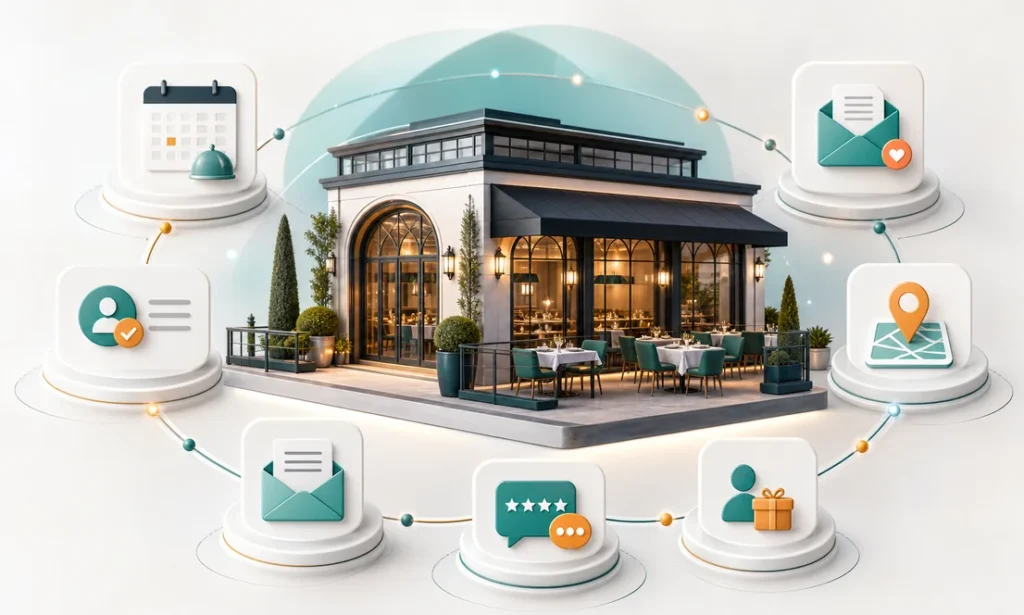
Running a restaurant means you’re a chef, a scheduler, an HR department, and a firefighter — usually before noon. Marketing is the job that gets whatever energy is left, which is why it happens in bursts: a flurry of posts one week, silence for a month. Restaurant marketing automation is the fix for that feast-or-famine pattern. You set up the system once, and it keeps working every week — bringing back past guests, filling slow nights, and asking for reviews — whether you had time to think about marketing or not.
Here’s the way I explain it to owners: your dining room has systems. Prep lists, par levels, closing checklists. Nobody “remembers” to stock the walk-in; the system handles it. Your marketing deserves the same treatment.
What Restaurant Marketing Automation Actually Covers
It’s not robots writing your Instagram captions. In practice, the useful automations are surprisingly unglamorous:
- Guest database building. Every online order, reservation, and WiFi login quietly adds a contact — with permission — to a list you own. Not rented from a delivery app. Yours.
- Win-back messages. A guest who hasn’t been in for a while gets a friendly nudge, maybe with a reason to return. Sent automatically, based on their actual visit history.
- Slow-night campaigns. A Tuesday-afternoon email or text that goes out every week to fill that evening’s tables, without you lifting a finger.
- Review requests. After a visit or an online order, a short message asks happy guests to share the experience. Consistency here compounds — a steady trickle of fresh reviews tends to matter more than a burst of old ones.
- Birthday and anniversary touches. The oldest play in hospitality, finally executed reliably.
Why “Set It Once” Beats “Post More Often”
Most restaurant marketing advice boils down to “do more” — more posts, more reels, more hustle. That advice fails because it depends on your busiest person (you) having spare time forever. Automation flips the equation: effort once, results weekly.
The other advantage is memory. A human marketer forgets which guests came in last month. A system doesn’t. When your messages are triggered by real guest behavior — first visit, tenth visit, gone quiet, big spender — they land as thoughtful instead of spammy. That’s the difference between marketing people tolerate and marketing that actually fills tables. It’s also why we insist on measurement: our data-driven digital marketing approach ties every campaign to covers and orders, not likes.
The Starter Stack: What to Automate First
- Capture contacts at every touchpoint. Online ordering, reservations, receipts with a QR code. If you skip this step, nothing else works — you can’t message a list you don’t have.
- Turn on review requests. Lowest effort, fastest visible payoff. New reviews influence the people searching “restaurants near me” tonight.
- Build one win-back flow. One message, one offer, triggered when a regular goes quiet. Keep it warm and human — write it like you’d talk at the pass.
- Schedule one weekly campaign. Pick your slowest night and aim everything at it. One clear offer beats five clever ones.
- Only then touch ads. Paid traffic pointed at a restaurant with no capture system is a leaky bucket. Fix the bucket first.
What It Costs — and the Honest Trade-Offs
Off-the-shelf marketing platforms for restaurants typically land in the $200–$600 per month per user range once you add the modules that matter (SMS, loyalty, integrations). That’s a real cost, but compare it to what one extra filled Tuesday is worth to you each week — many owners find the math works quickly if the system is actually used.
The alternative is a custom setup: a one-time project that connects your POS, online ordering, and messaging exactly the way your operation runs, with maintenance typically around 15–20% per year afterward. That route makes sense for multi-location operators or anyone whose tools refuse to talk to each other. It’s the same discipline we apply to any business process automation project: map the workflow first, automate second.
And the honest part: if your food or service has a problem, automation will only help more people discover it faster. Fix the product before you amplify it. Marketing automation multiplies whatever is already true about your restaurant.
Mistakes That Turn Automation Into Spam
- Messaging too often. Weekly is plenty for most concepts. Daily texts get you blocked, and rightly so.
- Discounting by default. Not every message needs 20% off. New menu items, events, and chef stories keep margins intact.
- Ignoring consent rules. Text messaging has real opt-in requirements. Get permission properly — it’s both the law and better marketing, since you’re only talking to people who want to hear from you.
- Setting and forgetting forever. “Set it once” means the system runs weekly without you — not that you never review it. A monthly fifteen-minute check on what’s working keeps the machine sharp.
Frequently Asked Questions
Do I need a big database for restaurant marketing automation to work?
No. A few hundred real guests who know your food will outperform a purchased list of thousands every time. Start capturing today; the list builds itself from your normal traffic.
Email or text — which works better for restaurants?
They do different jobs. Texts get read fast, which suits same-day “tonight” offers. Email carries more — menus, stories, events. Most restaurants do best using both, sparingly.
Can’t the delivery apps just do this for me?
They market to their customers, not yours — and they charge you for the privilege. The whole point of owning your guest list is that repeat visits stop costing you a commission.
If you’d rather run the kitchen than run campaigns, that’s exactly the point of automation. Schedule a free consultation and we’ll sketch out a system that fills tables while you work the line.
Finding this analysis useful?
Get one email a week with the most important developments in AI and business technology — explained in plain English, with real numbers and zero spam.
Want this working in your business?
Book a free 30-minute session: we look at your case and tell you what is worth doing (and what is not) — no strings, no sales pitch.
Book a free session →