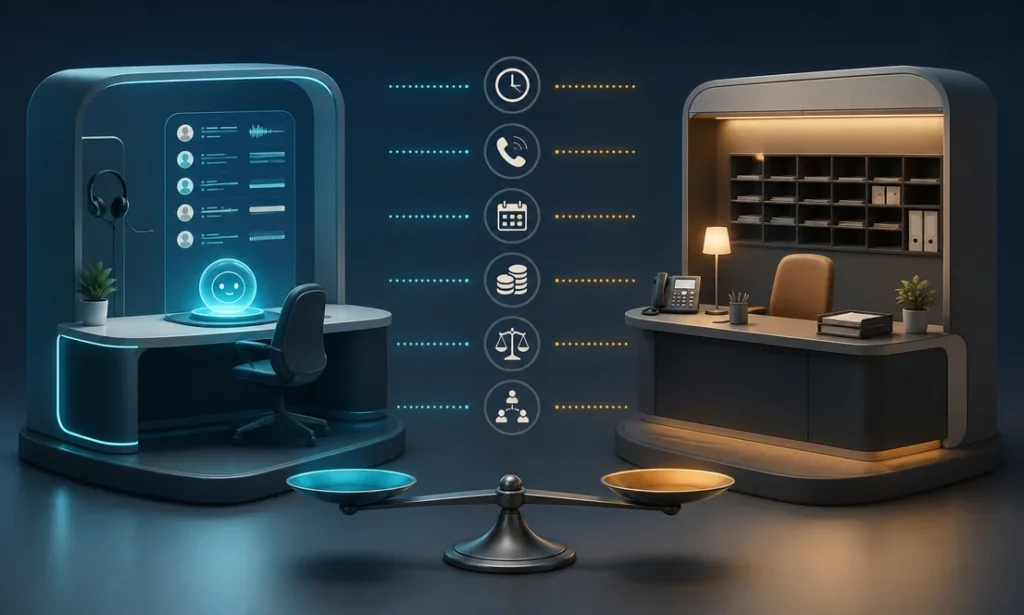
Owners ask me this one constantly: “Should I hire a receptionist or get the AI thing?” It sounds like a technology question. It is actually an accounting question, and the starting point is ai receptionist cost versus the fully loaded cost of a human hire — not the salary on the job posting, the fully loaded cost. Payroll taxes, benefits, paid time off, sick days, turnover, retraining, and the hours nobody covers. Let’s rank the scenarios and run the table, because the numbers don’t lie.
First, the honest framing
This is not “robot versus human, one must die.” The real question is which hours and which calls each option should own. A human is unbeatable in a tense conversation. Software is unbeatable at 2 a.m., on the fifth identical question of the day, and on never calling in sick. Most businesses that get this right end up with both, each doing what it is best at.
Ranked: where each option wins
- After-hours and weekend calls — AI wins, easily. Nobody staffs a front desk at midnight. An AI receptionist answers, books, and texts summaries while you sleep. This is the single highest-value slot, because these calls previously went straight to a competitor.
- Overflow during busy hours — AI wins. When two calls arrive at once, a human picks one. Software answers both. Every overflow call captured is revenue you were already generating and then dropping.
- Instant response to new leads — AI wins. Responding in minutes instead of hours dramatically raises close rates. Machines respond in seconds, every time, without being asked twice.
- Routine booking and FAQs — tie, decided by cost. Both handle “are you open Saturday?” fine. One of them does it for a subscription fee; the other does it for a salary. See the table below.
- Upset customers and complex quotes — human wins, decisively. No system should negotiate a commercial contract or calm down a customer whose kitchen is flooded. Route these to a person, immediately, with context.
- Being the face of your business — human wins. If clients walk into your office, a warm person at the desk is part of the product. Software cannot pour coffee.
The AI receptionist cost table, side by side
| Option | Upfront (USD) | Ongoing (USD) | Coverage |
|---|---|---|---|
| Subscription AI tool | Low — setup and configuration | $200–$600/month per user (typical generic-tool pricing) | 24/7, every call |
| Custom-built AI receptionist | One-time fixed-price project | Maintenance typically 15–20% of project cost per year | 24/7, wired to your exact calendar and CRM |
| Full-time human receptionist | Recruiting time and onboarding | Full salary plus payroll taxes, benefits, and coverage gaps at your local market rate | Roughly 40 hours/week, minus breaks, PTO, and sick days |
| Do nothing | $0 | Every missed call, forever | Whenever someone happens to be free |
I am deliberately not printing a fake “average receptionist salary” here — it varies too much by city and role to be honest about. Pull your own local number, load it with roughly what payroll actually costs you, and set it next to that first column. The comparison does its own talking.
The hybrid math most owners land on
The highest-ROI configuration I see is not either/or. It is: software owns nights, weekends, overflow, and routine bookings; your human owns walk-ins, escalations, and anything with emotion in it. That typically means you do not hire the second receptionist you were about to need, which is where the savings actually live. If the receptionist is one piece of a bigger workflow problem — intake, dispatch, follow-up — look at full business process automation rather than a point tool, because the phone is usually just the first bottleneck you noticed.
Watch the fine print on “AI pricing”
Two warnings from the spreadsheet trenches. One: per-user subscription pricing compounds — $200 to $600 per month per user feels small until you have five users. Two: some vendors bolt a chatbot onto everything and call it a receptionist; if you are evaluating conversational AI more broadly, compare against real ChatGPT-for-business pricing before paying a premium for a wrapper. Know what the underlying capability costs before you buy the packaging.
How to pressure-test any AI receptionist cost quote
Whatever a vendor quotes you, run it through three filters. Filter one: total cost at your real headcount — per-user pricing means the sticker price is rarely your price. Filter two: year-two cost — subscriptions repeat forever, while custom builds drop to maintenance at typically 15 to 20 percent of the project. Filter three: cost per captured call — divide the monthly fee by the number of calls you currently miss in a month, and ask whether a single booked job covers it. For most service businesses with a real missed-call problem, that last division settles the argument in one line of arithmetic. Bring the same discipline to add-ons — texting, recordings, integrations — because line items are where tidy quotes go to gain weight. And if a vendor cannot tell you plainly what happens to the AI receptionist cost as you grow, assume it grows faster than you do.
The verdict
If you have zero front-desk coverage today, start with AI — it covers 24 hours for less than any hire can. If you already employ a great receptionist, do not replace them; extend them with software on nights and overflow. And if your phone barely rings? Spend nothing here and fix lead flow first. The right answer falls out of your own call log, not anyone’s sales deck.
Want a second set of eyes on your specific numbers? Schedule a free call and bring your call volume — we will do the math live.
Finding this analysis useful?
Get one email a week with the most important developments in AI and business technology — explained in plain English, with real numbers and zero spam.
Want this working in your business?
Book a free 30-minute session: we look at your case and tell you what is worth doing (and what is not) — no strings, no sales pitch.
Book a free session →