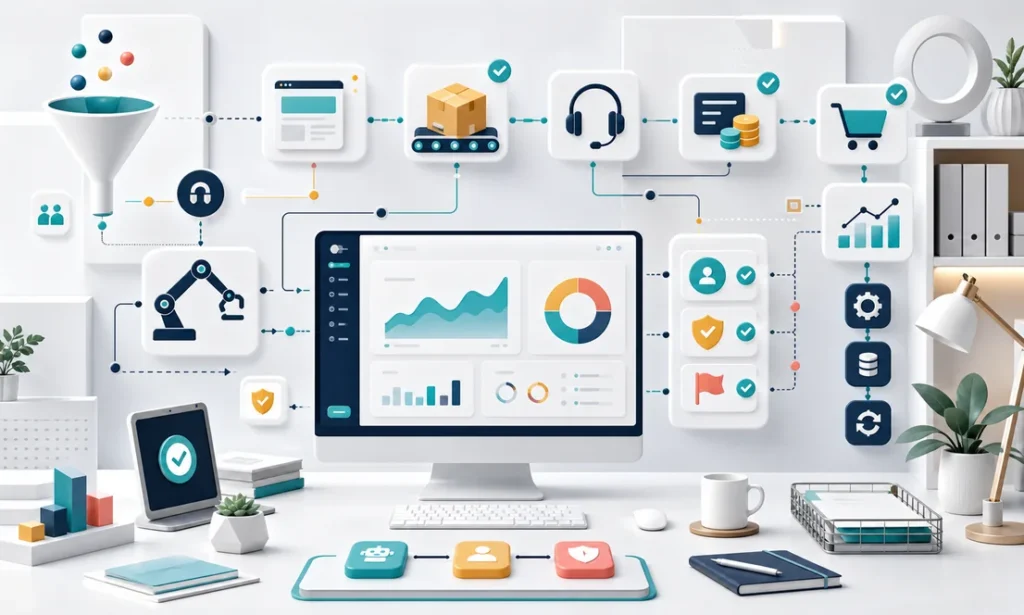
Type “how to start an automated business” into any search bar and you will find two kinds of advice: get-rich-quick fantasies about passive income, and enterprise automation guides written for companies with 500 employees. Neither helps the person actually asking. This guide sits in the useful middle. An automated business is not a business with no work — it is a business where software handles the repeatable work so the humans handle judgment, relationships, and growth. Here is how to build one in 2026, step by step, with real numbers.
Start with a model that automates well
Some businesses are structurally easier to automate than others. Before you pick tools, pick a model where the core transaction can run without you touching it. Strong candidates include digital products and templates, subscription services with standardized delivery, e-commerce with outsourced fulfillment, productized services (fixed scope, fixed price, repeatable process), and booking-based businesses where scheduling, reminders, and payment all happen in software.
The common thread: the customer’s path from “interested” to “paid and served” follows the same steps every time. If every sale requires a custom proposal and a negotiation, you can automate pieces of it, but the engine still needs a driver. That is fine — most successful automated businesses automate 70-80% of operations, not 100%.
Map the process before you buy a single tool
This is where most people get it backwards. They subscribe to six platforms, connect them with duct tape, and end up managing the tools instead of the business. Do it in the opposite order: write down every step from first customer contact to money in the bank. For each step, ask three questions. Does this step follow a rule a computer could execute? Does it happen more than ten times a month? Does a mistake here cost real money or a customer?
Steps that score yes-yes-no are your first automation targets: invoicing, appointment reminders, order confirmations, follow-up emails, inventory alerts. Steps that score yes on the mistake question — refunds, complaints, anything legal — stay human-reviewed until the automated version has proven itself. We walk through this exact mapping exercise in our guide to business process automation, and it is the single highest-leverage hour you will spend on this project.
Build the stack in three layers
Think of your automation stack like a house: foundation, plumbing, and finishes.
Layer 1 — the system of record. One place where customer data, orders, and payments live. For most new businesses this is an e-commerce platform, a CRM, or a booking system. Pick one and make it the source of truth.
Layer 2 — the connectors. Automation platforms (Zapier, Make, or native integrations) that move data between tools: new order triggers invoice, invoice triggers fulfillment, delivery triggers review request. In 2026, AI agents increasingly handle the fuzzy middle steps — drafting replies, categorizing requests, extracting data from documents — that pure rule-based tools could not.
Layer 3 — the customer-facing surface. Your website, checkout, chatbot, and email sequences. This is what customers actually experience, so polish it last but polish it hardest.
Off-the-shelf tools cover layers 1 and 3 well for standard models. Where businesses hit a wall is layer 2 at scale — when your workflow is unusual enough that no integration exists. That is the point where custom software development stops being a luxury and starts being cheaper than the workarounds.
Know what stays human — on purpose
Every automated business that lasts keeps humans on three jobs. First, exceptions: the order that ships to the wrong address, the customer who needs something the FAQ cannot answer. Second, quality control: sampling automated outputs weekly to catch drift before customers do. Third, strategy: pricing, positioning, and deciding what to automate next. Automating these is how businesses quietly rot. A good rule: automation executes decisions, humans make them.
What it actually costs to start
A realistic 2026 budget for a lean automated business: $100-$400 per month in software subscriptions (platform, email, automation connectors, accounting), $2,000-$10,000 one-time if you hire help to design and wire the workflows properly, and 60-100 hours of your own time in the first three months. If your model needs custom software — a client portal, a specialized calculator, an integration nobody sells — expect $15,000-$50,000 for a focused first version built by a nearshore team, roughly 40-60% below typical US agency pricing for the same scope. Compare that to the cost of hiring your first operations employee at $45,000-$60,000 a year, and the math usually favors building the machine first and hiring humans for the work machines are bad at.
FAQ: how to start an automated business
Can a business really run 100% automated?
Almost never, and chasing 100% is a trap. The best operators automate the repeatable 70-80% and deliberately keep exceptions, quality checks, and strategy human. That last 20% is where customers decide whether they trust you.
Do I need to know how to code?
Not to start. No-code platforms cover most standard workflows. You need technical help when your process outgrows what those tools connect — usually somewhere between $20,000 and $50,000 in monthly revenue, when manual workarounds start costing more than software.
What should I automate first?
The task you do most often that follows the same steps every time — usually invoicing, scheduling, or follow-up emails. Quick wins fund your patience for the bigger builds.
If you are mapping out an automated business and want a second set of eyes on the workflow — or a build partner for the custom pieces — schedule a free consultation and we will pressure-test the plan with you.
Finding this analysis useful?
Get one email a week with the most important developments in AI and business technology — explained in plain English, with real numbers and zero spam.
Want this working in your business?
Book a free 30-minute session: we look at your case and tell you what is worth doing (and what is not) — no strings, no sales pitch.
Book a free session →