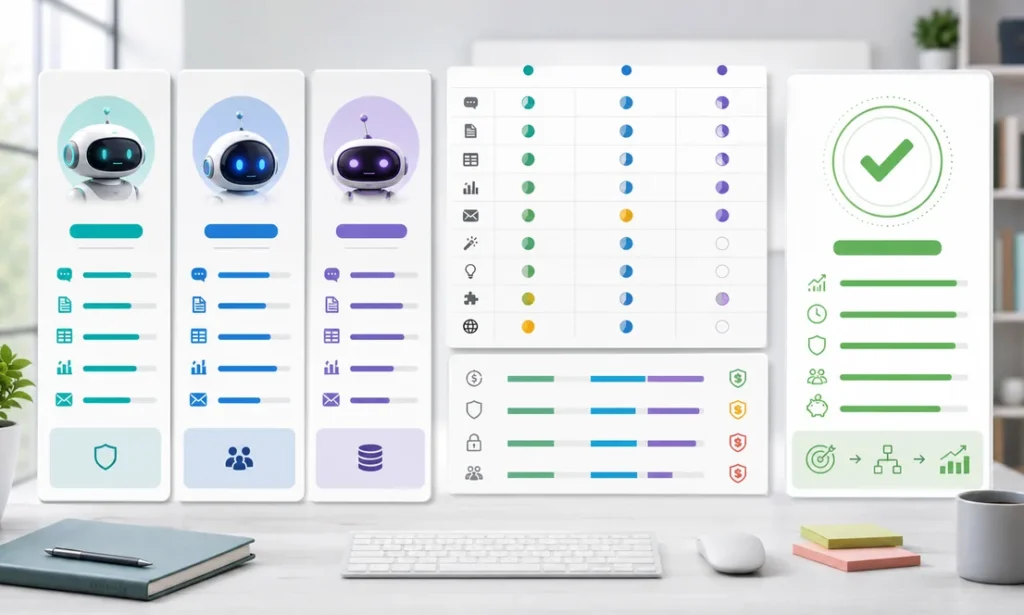
The ChatGPT for Business vs Claude decision just got more interesting — and cheaper. In April 2026, OpenAI cut ChatGPT Business pricing to $20 per user per month on annual billing (from $25), months after renaming the plan from “ChatGPT Team.” Anthropic’s Claude Team plan sits at exactly the same $20 annual price point for its standard seat. When the two leading AI platforms for business land on identical sticker prices, the decision stops being about budget and starts being about fit — which is where most companies actually get it wrong.
We compared both business plans as they stand in July 2026, using each vendor’s published pricing and documentation. Here’s what the fine print says, and how to choose without running a six-month bake-off.
The 60-Second Summary
- Same entry price: both ChatGPT Business and Claude Team standard seats cost $20/user/month billed annually, or $25 billed monthly. Both start at just 2 seats.
- Claude has a premium tier; OpenAI doesn’t at this level. Claude Team Premium seats ($100–$125/user/month) buy roughly 5x more usage for heavy users — a mid-step OpenAI only addresses with Enterprise.
- Both exclude your data from model training by default on business plans, and both offer SSO and admin controls.
- Different centers of gravity: ChatGPT Business leans broad — 60+ connectors and the widest general-purpose feature set. Claude Team leans deep on coding (Claude Code is included) and long-document work.
- Enterprise tiers are custom-priced at both vendors, adding SCIM provisioning, audit/compliance tooling, and data residency options.
What Each Plan Actually Includes, in Plain English
ChatGPT Business is OpenAI’s plan for teams of two on up. Per OpenAI’s published materials, it includes access to the company’s flagship models, a shared workspace with an admin console, SAML SSO, SOC 2 Type 2 compliance, more than 60 data connectors to tools your team already uses, and a commitment that business data is excluded from model training by default. Third-party pricing trackers also note the plan includes OpenAI’s agent and deep-research capabilities that used to require higher tiers. The pitch is breadth: one subscription that touches writing, analysis, coding help, research, and integrations across your stack.
Claude Team is Anthropic’s equivalent, for teams of 2 to 150 (beyond that, you’re in Enterprise territory). Standard seats cost $20/user/month annually or $25 monthly and include everything in Claude Pro — notably Claude Code, Anthropic’s agentic coding tool, plus projects and the long context window Claude is known for. Premium seats at $100/user/month annually (or $125 monthly) carry roughly five times the usage of standard seats, aimed at developers and analysts who hit limits daily. Team plans add central billing, SSO, domain capture, role-based access, enterprise search across connected tools (Google Drive, Slack, Microsoft 365, GitHub), and the same default: no training on your data. Usage limits are per member, so one power user can’t starve the rest of the team, and organizations can buy extra usage credits when someone needs more headroom.
ChatGPT for Business vs Claude: Side by Side
| ChatGPT Business | Claude Team | |
|---|---|---|
| Price (annual billing) | $20/user/month | $20/user/month (standard seat) |
| Price (monthly billing) | $25/user/month | $25/user/month (standard seat) |
| Premium option | None at this tier — next step is Enterprise | Premium seat: $100/user/mo annual, $125 monthly, ~5x usage |
| Minimum seats | 2 | 2 (up to 150 before Enterprise) |
| Data used for training? | No, by default | No, by default |
| SSO / admin controls | SAML SSO, admin console, SOC 2 Type 2 | SSO, domain capture, role-based access, admin controls |
| Connectors / integrations | 60+ data connectors | Enterprise search across Google Drive, Slack, Microsoft 365, GitHub |
| Standout inclusion | Broadest general toolset; agent and research features | Claude Code included; long-context document work |
| Enterprise tier | Custom pricing; SCIM, RBAC, data residency, 24/7 support | Custom (seat + usage); SCIM, audit logs, compliance API, HIPAA-ready option |
What does this mean for your business?
In a free 30-minute session we'll show you how to put technology like this to work in your operation — no hype, real numbers, concrete steps.
What This Means for Your Company
If you’re choosing on price, stop. At $20 per seat either way — roughly $4,800 a year for a 20-person rollout — the subscription is a rounding error next to the real cost driver: whether your team actually uses the thing. A tool that fits your workflows at $25/user beats a tool that doesn’t at $20/user by thousands of dollars per employee in recovered time. Run the pilot, not the spreadsheet.
The premium-seat structure matters more than it looks. Most teams have a usage pyramid: a few heavy users, many moderate ones. Claude’s mixed-seat model (standard seats for most, premium for the two developers living in it) prices that pyramid directly. With OpenAI, a team whose power users outgrow Business limits faces a bigger jump — Enterprise is custom-priced and aimed at larger organizations. For a 10-person company with 2 heavy users, that structural difference can matter more than any benchmark.
Security checkboxes are near parity — governance is on you. Both platforms handle the basics business buyers ask about first: no training on your data, SSO, admin visibility. What neither subscription solves is the layer where AI rollouts actually fail: which tasks are approved, what data can be pasted where, and who checks outputs before they reach customers. That’s policy and training work, not procurement work.
Model quality is a moving target — don’t marry a snapshot. Both vendors ship major model updates multiple times a year, and each release reshuffles benchmark standings. If you’re weighing the current flagship models specifically, our breakdown of GPT-5.6 Sol vs Claude Fable 5 for business goes deeper on capabilities. For the subscription decision, buy the fit, not this month’s leaderboard.
How to Decide in Two Weeks Instead of Six Months
- List your top five use cases in concrete terms: “draft customer proposals,” “summarize contracts,” “help with our Python data pipeline” — not “increase productivity.”
- Run both on those five tasks for two weeks. Both vendors’ entry plans start at 2 seats, so a head-to-head pilot costs well under $100 total. Have the people who’d use it daily do the testing — not the buying committee.
- Score three things: output quality on your work, how often users hit usage limits, and how well it connects to the tools where your work already lives.
- Then match the seat structure to your usage pyramid and negotiate annual billing. If nobody hit limits and quality tied, pick the one your team gravitated to — adoption is the metric that pays.
Rollouts stall on people, not models: teams that skip use-case definition and training see licenses go dormant by month three. If you’d rather compress the evaluation — or you’re deciding between subscriptions and API-based automation for specific workflows — our technology consulting team runs this exact exercise with companies and hands you the scorecard.
FAQ
Is ChatGPT Business or Claude Team better for a small company?
In the ChatGPT for Business vs Claude matchup, company size matters less than workload mix. For general business breadth — marketing, research, integrations across many tools — ChatGPT Business’s connector ecosystem is hard to beat. For teams where coding or long-document analysis is central, Claude Team’s inclusion of Claude Code and its mixed standard/premium seats often deliver more value per dollar. Identical entry pricing means a two-week pilot answers this better than any article can.
Do these plans train AI models on our company data?
No. Both ChatGPT Business and Claude Team exclude customer business data from model training by default, per both vendors’ published documentation. Enterprise tiers at both add stronger contractual and residency controls if your compliance needs go further.
Can we use both?
Plenty of companies do — at $20 per seat, giving different teams different tools costs less than forcing a bad fit. The practical caution is governance sprawl: two admin consoles, two data-access reviews, two sets of usage policies. If you go dual-platform, assign one owner for both.
Finding this analysis useful?
Get one email a week with the most important developments in AI and business technology — explained in plain English, with real numbers and zero spam.
Sources
- OpenAI — ChatGPT Business pricing
- Suprmind — ChatGPT pricing tracker (2026)
- Anthropic — Claude plans and pricing
- Claude Help Center — What is the Team plan?
Deciding how AI fits your company’s actual workflows is a bigger lever than picking the logo. Schedule a 30-minute call and we’ll help you build the two-week pilot that settles it.
