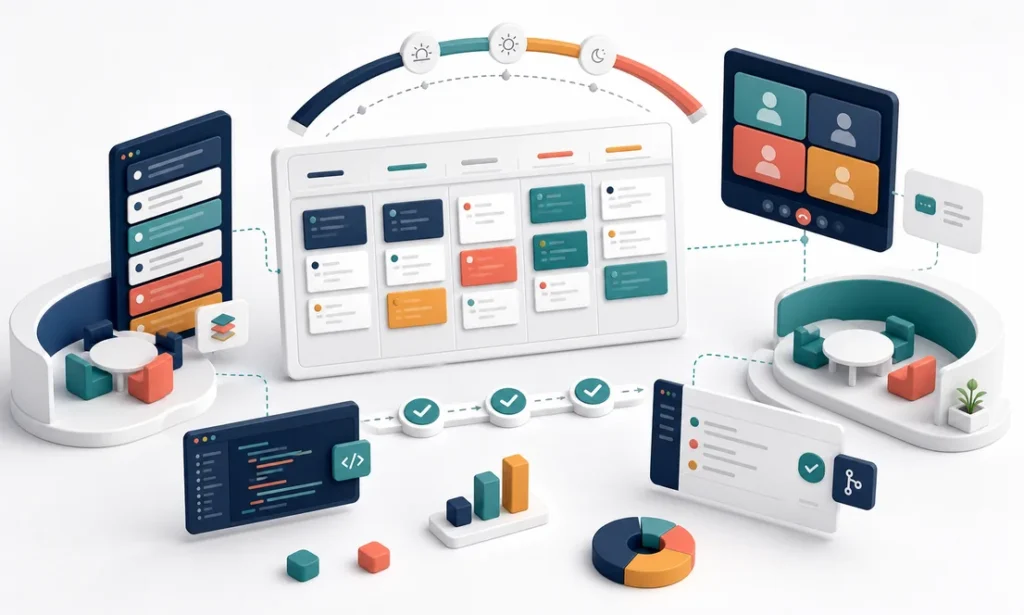
Agile was born in rooms with whiteboards, sticky notes and everyone within shouting distance. So when a company considers moving part of its development south of the border, the first worry is almost always the same: will our sprints survive the distance? After running this model for years, our answer is consistent. An agile nearshore team does not break your process. It exposes the parts of your process that were already fragile, and it forces you to fix them.
Think of it like a restaurant that opens a second kitchen. The recipes do not change. What changes is that the chef can no longer coordinate by yelling across the room. You need tickets, stations and timing. The food stays the same; the coordination gets more deliberate. That is exactly what happens to your sprints.
What stays exactly the same
More than most teams expect. If your process works in one office, these pieces transfer without modification:
- Sprint length. Two-week sprints remain the default. Distance is not a reason to stretch them.
- The ceremonies. Planning, daily standup, review and retrospective all happen, on video instead of in a room.
- Definition of done. Code reviewed, tested, merged, deployed to staging. If anything, it gets stricter, because nobody can lean over a desk to say "it works on my machine."
- Your backlog tool. Jira, Azure DevOps, Linear — the nearshore squad works inside your instance, not a parallel one.
What actually changes with an agile nearshore team
Three things change, and all three are upgrades in disguise.
First, writing replaces hallway memory. In a single office, half the decisions live in conversations nobody recorded. With an agile nearshore team, acceptance criteria go into the ticket before planning, and decisions get a written trail. Six months later, when someone asks why the invoice module rounds the way it does, the answer exists.
Second, demos become the heartbeat. Instead of trusting that work is advancing because you can see people typing, you see working software every sprint review. Progress becomes visible in the product, not in the office.
Third, the product owner role gets sharper. Ambiguous priorities that a co-located team absorbs through osmosis now surface as explicit questions in the first two days of the sprint. That feels uncomfortable for a month and then becomes the best thing that ever happened to your backlog.
The time zone advantage nobody talks about
Here is where nearshore separates from offshore. Our teams work from Chihuahua, Mexico, on Central Time — the same clock as Dallas, Austin and Houston, one hour from Denver, two from California. A 9:15 a.m. standup is 9:15 a.m. for everyone. Planning on Monday morning, review on Friday afternoon, and a developer who hits a blocker at 2 p.m. gets unblocked at 2:05, not tomorrow.
Compare that with a team ten time zones away, where every question waits overnight and a two-week sprint quietly loses two or three days to latency. Full-schedule overlap is the single biggest reason nearshore software development keeps agile intact while offshore models bend it out of shape.
Artifacts matter more than meetings
Distributed agile lives or dies on a few concrete artifacts. We consider these non-negotiable:
- Acceptance criteria on every story before it enters the sprint, written as testable statements.
- A decision log — one page where technical and product decisions get a date, an owner and a reason.
- Recorded sprint reviews, so stakeholders who miss the call still see the demo.
- A visible board that reflects reality by end of day, every day.
None of this is exotic. It is the discipline most co-located teams claim to have and quietly skip.
How to tell it is working by sprint three
You do not need faith; you need three signals. Velocity should stabilize into a predictable range by the third sprint, once the team has absorbed your domain. Questions should cluster at the start of the sprint, not explode at the demo. And rework — stories reopened after review — should trend down sprint over sprint. If those three lines move the right way, the model works. If they do not, the problem is almost never geography; it is usually an unclear backlog or a missing product owner.
One more structural decision shapes everything above: whether the nearshore developers join your existing squad or run as a self-contained team with their own ceremonies. The mechanics differ enough that we compared both models in detail in our guide to staff augmentation vs project outsourcing.
Frequently asked questions
Do we need a Scrum Master on each side?
No. One facilitator is enough, on whichever side has the stronger process muscle. What you do need is a single product owner with real authority to prioritize. Two backlogs or two deciders will hurt you far more than distance ever will.
Should we change our sprint length?
Keep whatever cadence you run today. The only teams we advise to shorten sprints are those coming from four-week cycles, because faster feedback matters more when the team is new to your domain.
How long until the team is genuinely productive?
Plan for two sprints of ramp-up. By sprint three you should see stable velocity, and by the second month the team should be indistinguishable in output from an internal squad — at 40 to 60 percent below U.S. rates.
If you want to see what your sprint calendar would look like with a nearshore squad on your same clock, schedule a 30-minute call and we will walk you through it with a real example.
Finding this analysis useful?
Get one email a week with the most important developments in AI and business technology — explained in plain English, with real numbers and zero spam.
Want this working in your business?
Book a free 30-minute session: we look at your case and tell you what is worth doing (and what is not) — no strings, no sales pitch.
Book a free session →